This glossary defines 82 terms used in designing, building and permitting geodesic domes and zomes: the geometry (zonohedron, frequency, chord factor), the framing (hub, strut, panel jig, riser wall), greenhouses and coops (sash, stack effect, hardware cloth) and the codes (R105.2, Appendix AQ, ADU). Every term has its own link anchor.
Numbers from our own plans were measured from the built models. For quick reference, here are the part counts of a complete polar zonohedron at the fold counts we build, from George Hart’s formulas (faces n(n-1), edges 2n(n-1), vertices n(n-1)+2, at most n/2 rounded down different face shapes). A zome is cut off at a chosen ring, so it uses only part of these.
| Folds (n) | Faces | Edges | Vertices | Face shapes | Our zomes at this fold |
|---|---|---|---|---|---|
| 7 | 42 | 84 | 44 | 3 | Maia coop |
| 8 | 56 | 112 | 58 | 4 | Spica 12, Alcyone, Taygeta, Altair, Rigel, Antares |
| 9 | 72 | 144 | 74 | 4 | Mira 16, Harvest Moon |
| 10 | 90 | 180 | 92 | 5 | Spica 16, Gemma 22 |
| 12 | 132 | 264 | 134 | 6 | Spica 25, Capella, Arcturus, Vega, Triangulum |
| 14 | 182 | 364 | 184 | 7 | Borealis 40, Polaris 48 |
A
ADU
An accessory dwelling unit: a second, smaller home on a lot with a house, attached or detached. State laws limit how far cities can restrict them; California’s guarantees room for an 850 or 1,000 sq ft unit (permits).
Air changes per hour
How many times a building’s whole volume of air is replaced in an hour (ACH). Greenhouse guidance asks for about one air change a minute in summer and two to three an hour in winter (dome greenhouse).
Anchor bolt
A threaded rod cast into a footing to hold a wall’s bottom plate down. On light glazed buildings it resists wind uplift.
Appendix AQ
The tiny-house appendix of the 2021 International Residential Code (Appendix Q in 2018). It relaxes ceiling-height, loft and stair rules for dwellings of 400 sq ft or less excluding lofts, but only where a state or city adopts it (permits).
Axial angle
In a hub-connected geodesic dome, the angle between a strut and the line from its end vertex to the sphere’s center. Panels built on jigs work from miters and dihedral angles instead.
B
Base plate
The timber on top of a knee or riser wall that the shell’s bottom row sits on. Ours is one 4x4 per side, its top ripped to the bottom row’s lean.
Bevel
An angle cut through a board’s thickness along an edge, as opposed to a miter across its face. Our plywood skins have each shared edge ripped at half the joint’s angle so neighboring sheets meet tight.
Buckling
How a long, slender member fails in compression: it bows sideways rather than crushing. Our structural checks give the hardest-loaded strut as a percentage of its buckling load.
C
Cap
On our glazed shells, a strip of aluminum bent over the joint between panes and screwed through to the frame on butyl tape.
Cheek
One of the flat panels that close the sides of a dome’s door notch, so a plumb door frame can stand in a curved shell.
Chord factor
A geodesic strut’s length divided by the sphere’s radius. Multiply each chord factor by your radius to get the strut lengths, or let the geodesic dome calculator do it.
Class I and Class II
Two ways of dividing an icosahedron’s faces into triangles. Class I (alternate) divides each face with lines parallel to its edges; Class II (triacon) uses lines square to the edges, giving a different strut pattern.
Collapse mode
In a truss check, a way a frame can move without any member changing length: a mechanism, not just a weak spot. A glazed zome of plain diamonds has more than 20; level rails remove them (zome greenhouse).
Compound miter
A cut that is mitered across a board’s face and beveled through its thickness at once, as strut ends meeting at a dome vertex often need. Our panels avoid them: struts meet at plain miters inside each flat panel.
Crown
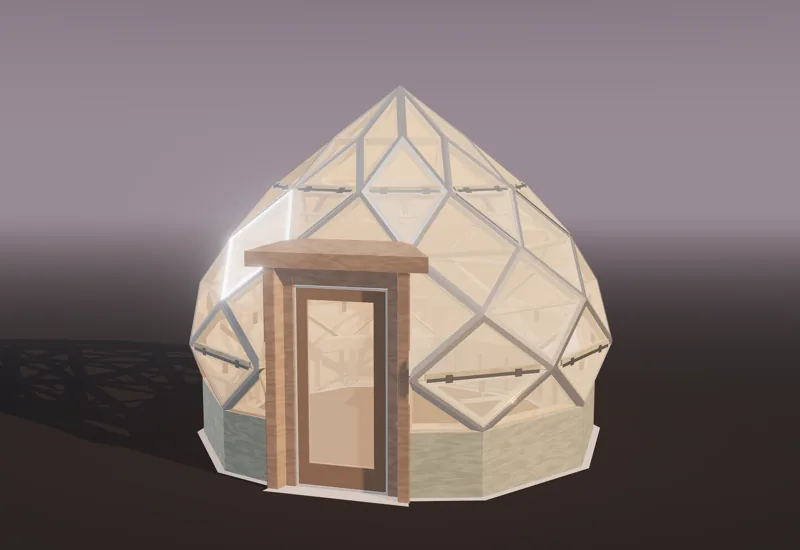
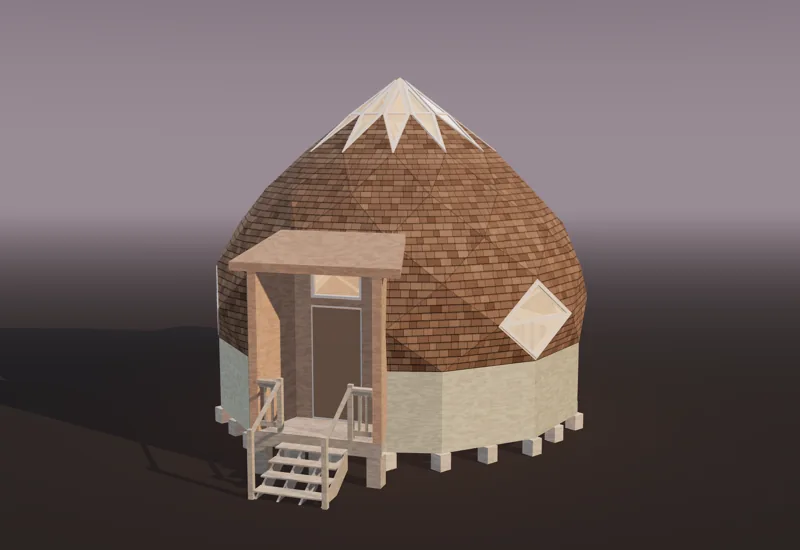
The topmost part of a dome or zome. On our zomes it’s the star of narrow diamonds at the pole: a skylight on homes, glazed on greenhouses, an always-open screened vent on coops.
D
Diamond
The everyday name for a rhombus panel of a zome.
Dihedral angle
The angle between two adjacent faces along their shared edge. It sets the bevel on any edges that must meet flush.
Drip edge
A metal edge or overhang that throws water clear of the surface below. On our coops the raised crown skins run 4” past the vent slot as a drip edge.
E
Engineered design
Design by an engineer’s calculations rather than the code’s prescriptive tables. IRC Section R301.1.3 requires it for structural elements outside the code’s conventional limits, which in practice covers most dome and zome homes (permits).
F
Flutes
The parallel channels inside twin-wall polycarbonate. Run them downhill so condensation drains, and seal the top ends with solid tape and the bottom ends with vented tape.
Fold
The order of a zome’s rotational symmetry, n: the number of diamonds in each ring and the number of spirals running each way. Our zomes run from 7-fold (the Maia coop) to 14-fold (the Borealis home).
Footing ring
A continuous concrete footing poured round under a building’s wall. Our greenhouses and walk-in coops stand on one whose top is the floor level, so a wheelbarrow rolls straight in.
Fraction
How much of a full sphere a geodesic dome keeps: 1/2 (a hemisphere), 5/8, 5/9 and so on. Odd frequencies have no level equator, so 3V domes are cut a little above or below it.
Frequency
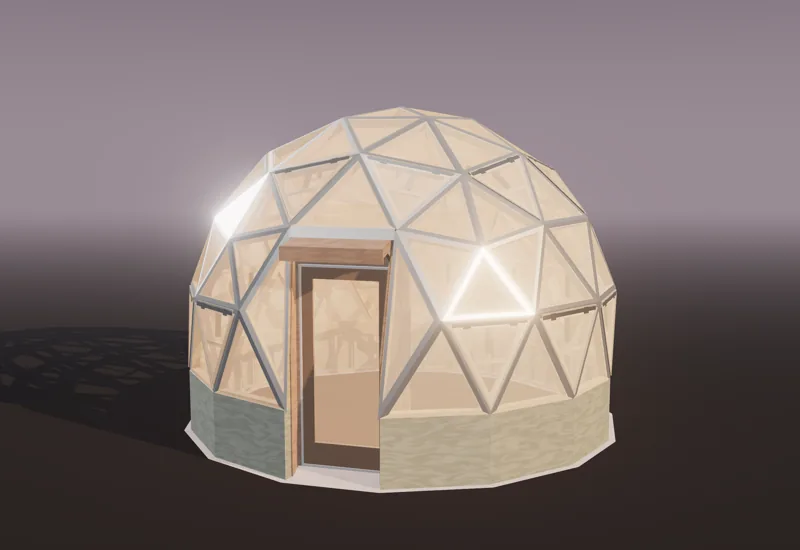
The number of segments each edge of the starting icosahedron is divided into, written 2V, 3V, 4V and so on. Higher frequency means more, smaller triangles and a rounder dome (geodesic domes).
G
Generator
One of the n equal edge vectors that build a polar zonohedron, spaced evenly around the axis at the same slope. Every edge of the zome is parallel to one of them.
Geodesic dome
A dome of triangles approximating part of a sphere, usually made by subdividing an icosahedron’s faces and pushing the new points out to the sphere. Walther Bauersfeld built the first, a planetarium in Jena in the 1920s; Buckminster Fuller named, patented (1954) and popularized it (geodesic domes).
Girder
A main beam under a floor that carries the joists and sits on piers. Our dome homes use one to three built-up girders depending on size.
Golden rhombus
A rhombus whose diagonals are in the golden ratio, about 1.618 to 1. It appears in icosahedral zonohedra such as the rhombic triacontahedron and in Zometool, and isn’t inherent to the 7- to 14-fold polar zonohedra most zomes are cut from.
H
Hardware cloth
Welded, galvanized wire mesh. For coops use 1/2” mesh of 19 gauge or heavier fixed under screwed battens; chicken wire keeps chickens in but doesn’t keep predators out (coops).
Hemisphere
Half a sphere; a geodesic dome cut at its equator. Even frequencies (2V, 4V, 6V) have a level equator to cut at.
Horizontal diagonal
The diagonal joining a zome diamond’s two side corners, which stand at the same height. It’s the only level line in a diamond, so on a glazed zome it carries the rail and the sash hinges.
Hub
A connector, usually metal, where strut ends meet at a dome vertex. Our plans don’t use them (hubs vs hubless panels).
Hubless panel
A flat triangle or diamond framed on a jig, then screwed to its neighbors along their edges, so no vertex connectors are needed. Every Starcrown plan is built this way (our method).
I
Icosahedron
The 20-faced Platonic solid of equilateral triangles. Most geodesic domes start from one, and its corners become the five-way vertices of the finished dome.
IRC
The International Residential Code, the model building code for one- and two-family homes. The International Code Council revises it every three years; states and localities adopt it with amendments.
J
Jamb
The side of a door or window opening. In our dome greenhouses the jamb strut along each side of the door notch is often the hardest-worked member in the frame.
Joist
One of the parallel beams that carry a floor. Our raised floors use 2x8 joists at 12” or 16” on center over girders.
K
Knee wall
A short wall under a sloping roof or shell. Our greenhouses stand on 2’ knee walls (the Solstice Dome 12 on 2’-10 3/4”) and our walk-in coops on 3’.
Kruschke method
A way of subdividing a 3V geodesic dome so that its base ring comes out level with only four strut lengths. Our Solstice Dome 16 and 22 greenhouses and the Deneb and Halo homes use it on a 5/9 dome.
L
Level
A ring of n identical diamonds in a zome, counted down from the pole. A full polar zonohedron has n-1 levels; a zome is cut off at a chosen level, which sets its base, its floor and its wall height.
Loft
In the tiny-house appendix, a floor level more than 30” above the main floor, open to it on at least one side, with a ceiling under 6’-8”, used for living or sleeping.
M
Miter
An angle cut across a board’s face at its end, so two members meet at a corner. Our panel struts join at plain miters, listed in each guide as degrees off square.
N
Nest box
Where hens lay. Extension guidance is about one per four hens, about 12” square, at least 18” up (coops).
Notch door
Our doorway for a dome: the panels round one base corner come out, two flat cheeks close the sides, and the door stands under a level head, set back in the notch, with no posts.
P
Panel jig
A flat plywood board with stop blocks screwed around a panel’s outline, so every panel of that shape comes out the same. Each Starcrown guide gives the jig for every shape, with corner positions to 1/16”.
Pitch angle
The slope of a polar zonohedron’s edges from horizontal; with the fold count it fixes the whole shape. Hart shows that about 35.26° gives the most volume for a given edge length; our greenhouse zomes pitch about 36.5°.
Polar zonohedron
A zonohedron built from n equal generators arranged evenly around an axis. It has n(n-1) rhombic faces in n-1 rings and two poles, and most zomes are one cut off at a chosen ring (Hart, The Joy of Polar Zonohedra; zome geometry).
Pole
One of the two n-way vertices on a polar zonohedron’s axis. On a zome, the top pole is the center of the star crown.
Pony wall
A short framed wall. Our zome homes stand on 3’ pony walls on a raised floor.
Pop door
The small, hen-sized door from a coop to its run, often on an automatic opener. Ours are 12” x 15” clear.
R
R-value
Resistance to heat flow, in ft²·°F·h/BTU (RSI in m²K/W). Higher insulates better; 8 mm twin-wall polycarbonate is about R-1.7.
R105.2
The IRC section listing work exempt from a building permit, including one-story detached accessory structures up to 200 sq ft. Many jurisdictions use 120 instead (permits; permit checker).
Rail
In a glazed zome, a level member across a diamond’s horizontal diagonal. It splits the diamond into two triangles and joins its neighbors into a level ring; panes give no shear stiffness, so the rails stop the frame racking.
Rhombic dodecahedron
The 12-faced polyhedron of identical rhombi that Kepler described. It is the 4-fold polar zonohedron.
Rhombic triacontahedron
The 30-faced polyhedron of identical golden rhombi, a zonohedron with icosahedral symmetry. It’s where the golden ratio in zome folklore comes from.
Rhombus
A four-sided figure with all four sides equal, its opposite sides parallel. Every face of a polar zonohedron is one (zome geometry).
Rim joist
The joist that runs across the ends of a floor’s joists around its edge, closing the floor frame.
Ring beam
A beam running around the perimeter of a raised floor, following the building’s polygon, that carries the wall and ties the floor together.
Riser wall
A short wall that lifts a dome off its floor or foundation, adding standing room at the edge. Our larger dome homes stand on 3’ riser walls; the Deneb and Halo on 2’ knee walls.
Roost
A perch where hens sleep. Allow about 8 to 10” of perch per bird, higher than the nest boxes; our plans leave roosts to the builder (coops).
Rough opening
The framed opening a door or window fits into, a little larger than the unit so it can be shimmed plumb and level.
S
Sash
A glazed frame that opens. On a zome greenhouse it’s the lower half of a diamond hung from its rail; on a dome, a whole triangle hung from its top edge.
Shear
Forces that push a shape out of square; a frame that gives way in shear is said to rack. A diamond racks unless something braces it; a triangle can’t.
Sheathing
Structural sheets, such as plywood or OSB, nailed to framing to stiffen it against racking. On our knee walls the sheathing also carries the shell’s wind uplift down to the anchor bolts.
Stack effect
Air movement driven by temperature: warm air rises and leaves by high openings while cooler air comes in low. It grows with the height between the openings and the inside-outside temperature difference (dome greenhouse).
Star crown
The ring of n narrow diamonds round a zome’s top pole, which reads from below as an n-pointed star. Our family rule keeps each zome’s top-point angle times its fold count near 287°, so the star looks equally full at every size.
Stressed-skin panel
A panel whose skin is fastened to its frame so the two work together, the skin taking in-plane shear. A plywood-skinned zome panel works this way; a glazed one doesn’t.
Strut
A straight member along one edge of a dome or zome. In our panels it’s a 2x3, 2x4, 2x6 or 2x8 on edge with mitered ends.
Surface helix
A pole-to-pole path of edges that turns the same way at every vertex. Every n-fold polar zonohedron has n right-handed and n left-handed ones: the spirals you see on a zome are counted by its fold, not by Fibonacci numbers.
T
Thermal mass
Heavy material, usually water, that soaks up heat by day and gives it back at night, evening out a greenhouse’s temperature swings. It stores heat; it doesn’t make it (dome greenhouse).
Tiny house
Under IRC Appendix AQ, a dwelling of 400 sq ft or less in floor area, excluding lofts.
Twin-wall polycarbonate
Glazing of two polycarbonate skins joined by ribs into flutes. It insulates nearly twice as well as single glass (a U-value of about 0.65 against 1.13 BTU/h·ft²·°F), diffuses light, and adds no useful shear stiffness to a frame.
U
U-factor
The rate of heat flow through an assembly per unit of area and degree of temperature difference, in BTU/h·ft²·°F (W/m²K). Lower is better; it’s the inverse of the assembly’s total R-value.
Uplift
The upward pull of wind on a roof or shell. Light glazed buildings feel it most: on our greenhouses a 115 mph wind lifts the worst base corner by roughly 150 to 1,020 lb.
V
Vapor retarder
A layer that slows water vapor moving through a wall or roof. The IRC classes them by permeance: Class I at 0.1 perm or less, Class II above 0.1 up to 1.0, and Class III above 1.0 up to 10 perms.
Vent area
The clear open area of a vent after screens and frames. We size greenhouse vents to at least 20% of the floor, and coop vents to 1 sq ft per hen or 1 per 10 sq ft of floor, whichever is larger.
W
Wax-cylinder opener
A vent opener that needs no power: wax in a sealed cylinder expands as it warms and pushes a piston that lifts the sash, then contracts to let it close.
Z
Zome
A building whose shell is cut from a zonohedron, usually a polar zonohedron, made of diamond panels in rings around a vertical axis. The word, from dome plus zonohedron, was coined in 1968 by Steve Durkee, and Steve Baer built the first zome homes (what is a zome; Wikipedia).
Zome Primer
Steve Baer’s 1970 booklet on zonohedron geometry for builders, published by Zomeworks, titled Zome Primer: Elements of Zonohedra Geometry.
Zometool
A construction toy descended from Baer’s ZomeToy, made from 1971 and redesigned as Zometool in 1992. Its struts follow icosahedral geometry and scale by the golden ratio, which is where many zome golden-ratio claims come from.
Zone
In a zonohedron, a closed band of faces that all share one edge direction. Each face sits where two zones cross.
Zonohedron
A convex polyhedron whose faces are centrally symmetric polygons, often all parallelograms, with edges in parallel sets. Formally it’s the Minkowski sum of line segments; a zome is cut from one (Hart).
Questions
Q01What is the difference between a zome and a geodesic dome?
A geodesic dome is made of triangles approximating a sphere, usually from a subdivided icosahedron. A zome is cut from a zonohedron and made of diamond-shaped panels in rings around a vertical axis, which makes it taller and gives it spiral lines.
Q02What does 3V mean on a geodesic dome?
It is the frequency: each edge of the starting icosahedron is divided into three segments. Higher frequencies give more, smaller triangles and a rounder dome.
Q03What is a polar zonohedron?
A polyhedron built from n equal edge vectors arranged evenly around an axis at the same slope. It has n(n-1) rhombic faces in n-1 rings and a pole at each end; most zomes are one cut off at a chosen ring.