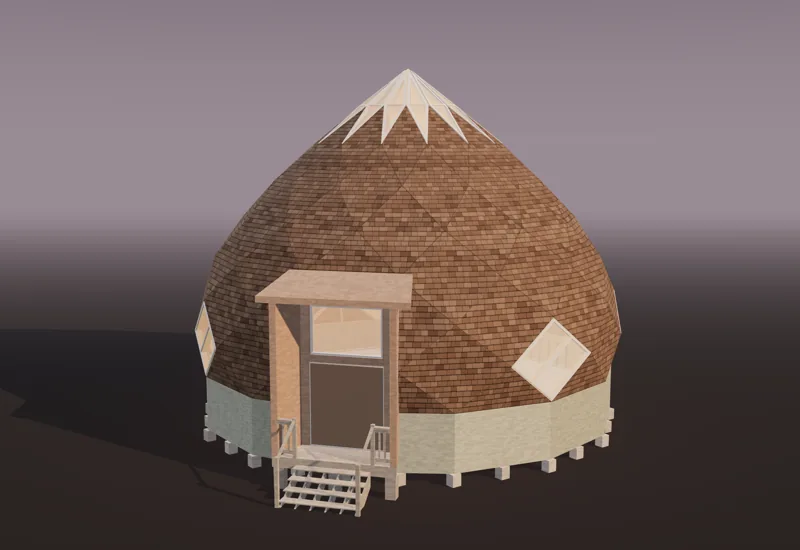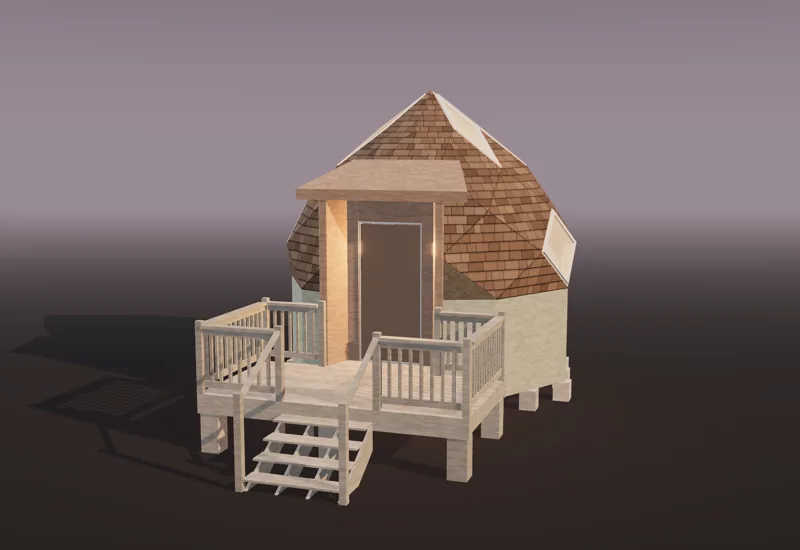
A zome is the top of a polar zonohedron: n equal edges (“generators”) tilted at an angle alpha from vertical and spaced 360/n degrees apart. Every corner is a sum of consecutive generators, every face is a rhombus, and one formula ties the star’s point angle to alpha: cos φ = cos²α + sin²α · cos(360°/n).
This page works through the geometry from those generators to the saw settings, and checks each step against the cut list of a real plan, the Capella Zome 25. To try any fold count or size in 3D, use the Zome Lab calculator. For the plain-words version, start with What is a zome?
The generators
Put the zome’s top point at the origin and the axis vertical. Choose:
- n, the fold count: how many diamonds in each row and points on the star;
- α (alpha), the angle of every edge from the downward vertical;
- e, the edge length.
The generators are n vectors of length e, all at alpha from vertical and spaced evenly around the axis:
g_i = e · ( sin α · cos(360° · i/n), sin α · sin(360° · i/n), −cos α ) for i = 0 … n−1That’s Hart’s umbrella: n ribs, partly open. George Hart measures the tilt from horizontal instead and calls it the pitch, so his pitch is 90° − α. Our zomes run at α of 52.5° to 53.8°, a pitch of about 36° to 37.5°.
Vertices are sums of consecutive generators
Every corner of the shell is reached by walking from the top along k consecutive generators:
P(i, k) = g_i + g_(i+1) + … + g_(i+k−1) (indices wrap around mod n)k is the vertex’s level. Level 0 is the top point; level k is a ring of n corners, all at the same height. Two useful results follow from summing the series:
height of level k below the top:   k · e · cos α
radius of level k:                 r_k = e · sin α · sin(180° · k/n) / sin(180°/n)
The rings widen until k reaches n/2, the waist, then narrow again, closing at the bottom point at level n. Each ring is also turned by half a step from the one above, which is what staggers the diamonds.
Check against the Capella (n = 12, e = 4’-0”, α = 53.45°): the base is cut at level 7, so the shell rises 7 × 4 × cos 53.45° = 16.68 ft (16’-8 1/4”) above the base, and the base ring’s radius is 4 × sin 53.45° × sin 105° / sin 15° = 11.99 ft. A 12-sided ring of that radius encloses about 431 sq ft. The plan’s guide gives about 430 sq ft inside the pony wall and 20’-1” from floor to crown: the same 16’-8” of shell plus the 3-foot pony wall and the base plate. (The engine measures to the inside face of the frame; the frame’s depth adds to the outside dimensions.)
Rows of rhombi
Fill the V between two neighboring generators and you get a rhombus; its corners are P(i, k), P(i, k+1), P(i−1, k+2) and P(i−1, k+1). The diamonds in row k are spanned by two generators k steps apart, so the angle at the top of each one comes from their dot product:
cos θ_k = cos²α + sin²α · cos(360° · k/n) k = 1 … n−1Row 1 is the star. The top angle grows row by row to a maximum at the waist and shrinks again below it; rows k and n − k are congruent. On an even fold count the waist row (k = n/2) stands vertical, and its top angle is exactly 2α.
Here is the Capella (n = 12, α = 53.45°, star angle 24.0°), row by row:
| Row | Top angle θ | Saw miter, abs(90° − θ) | Cut list miter | Face tilt from horizontal |
|---|---|---|---|---|
| 1 (star) | 24.00° | 66.0° | z1: 66.0° | 37.5° |
| 2 | 47.36° | 42.6° | z2: 42.6° | 40.6° |
| 3 | 69.23° | 20.8° | z3: 20.8° | 46.4° |
| 4 | 88.16° | 1.8° | z4: 1.8° | 56.0° |
| 5 | 101.78° | 11.8° | z5: 11.8° | 70.8° |
| 6 (waist) | 106.89° | 16.9° | z6: 16.9° | 90.0° |
| 7 (half panels on the base) | 101.78° | 11.8° | z5 half base | 70.8°, leaning in |
The struts are pinwheeled: at each corner one runs through and the next butts into its side, so each corner’s saw setting is simply how far its angle is from square. The computed miters match the plan’s cut list to the tenth of a degree.
Where the panels meet
Neighboring panels meet at a fold. The angle the surface turns at each joint (the angle between the two faces’ normals) is:
| Joint | Fold at the joint | Sheathing rip (half the fold) |
|---|---|---|
| Row 1 to row 2 | 9.9° | 5.0° |
| Row 2 to row 3 | 11.8° | 5.9° |
| Row 3 to row 4 | 15.1° | 7.6° |
| Star to star, across a rib | 18.1° | 9.1° |
| Row 4 to row 5 | 19.9° | 9.9° |
| Row 5 to row 6 | 24.2° | 12.1° |
Our panels touch along their inside edges and the sheathing closes the V outside, each sheet ripped at half the fold so neighbors meet tight over the joint. The Capella’s guide lists rips of 5°, 5.9°, 7.6°, 9.1°, 9.9° and 12.1°: the same six numbers. Hart gives the general dihedral formulas, via cross products of the generators, in the appendix of The Joy of Polar Zonohedra.
The top angle and alpha
Set k = 1 in the row formula and you get the star:
cos φ = cos²α + sin²α · cos(360°/n)and turned around, to find alpha from a chosen star angle:
sin²α = (1 − cos φ) / (1 − cos(360°/n))Worked example. The Capella’s star points are 24.0° and n = 12: sin²α = (1 − 0.91355) / (1 − 0.86603) = 0.6453, so α = 53.45°. Its guide says every edge “leans 53.45° from vertical.”
Two limits are worth knowing. The star angle is always less than 360/n; it approaches 360/n as alpha nears 90° (a flat pancake) and approaches zero as alpha nears 0° (a needle). So φ ÷ (360/n) is a natural measure of how open the crown is.
The Starcrown rule: top angle × folds ≈ 287°
Our design rule is that every zome’s star angle times its fold count stays near 287 degrees. In other words, φ ÷ (360/n) ≈ 287/360 = 0.797: each star point fills about 80% of its share of the circle. That keeps the crown equally full at every size, so a 9-fold pod and a 14-fold house look like one family.
What the rule does to alpha is the interesting part. For large n, φ ≈ (360°/n) · sin α, so holding the ratio at 0.797 is nearly the same as holding sin α at 0.797, that is α ≈ 52.9°. In practice the rule fixes the edge lean at about 53° for every fold count. That pitch also happens to sit near the volume-maximizing pitch Hart derives, 35.26° from horizontal (α = 54.74°), which is the rhombic dodecahedron’s.
Computed for n = 7 to 14, with the star angle exactly 287/n:
| Folds n | Star angle 287/n | α from vertical | Pitch from horizontal | Star faces’ tilt | Full solid: height ÷ width | Full solid’s volume vs the maximum for its edge | Our plans at this n |
|---|---|---|---|---|---|---|---|
| 7 | 41.00° | 53.82° | 36.18° | 39.1° | 1.14 | 99.92% | Maia |
| 8 | 35.88° | 53.59° | 36.41° | 38.6° | 1.13 | 99.88% | Spica 12, Rigel, Altair, Antares, Taygeta, Alcyone |
| 9 | 31.89° | 53.44° | 36.56° | 38.3° | 1.16 | 99.85% | Mira 16, Harvest Moon |
| 10 | 28.70° | 53.33° | 36.67° | 38.1° | 1.15 | 99.82% | Gemma 22, Spica 16 |
| 11 | 26.09° | 53.24° | 36.76° | 37.9° | 1.17 | 99.80% | |
| 12 | 23.92° | 53.18° | 36.82° | 37.8° | 1.16 | 99.78% | Capella, Arcturus, Vega (24.0°), Spica 25 (23.92°) |
| 13 | 22.08° | 53.14° | 36.86° | 37.7° | 1.17 | 99.77% | |
| 14 | 20.50° | 53.10° | 36.90° | 37.6° | 1.17 | 99.76% | Borealis, Polaris (20.33°) |
How to read it: alpha barely moves (53.1° to 53.8°), the star faces all tilt about 38° from horizontal (roughly 9 in 12, steep enough for shingles), and every complete solid in the family is a little taller than it is wide. The built models sit on the rule or within a degree of it: the 12-fold home shell at 24.0° (24.0 × 12 = 288) and the Borealis at 20.33° (20.33 × 14 = 284.6).
Size, height and where to cut the base
For the complete solid:
pole-to-pole height:   H = n · e · cos α
widest radius:         R = e · sin α · sin(180° · floor(n/2) / n) / sin(180°/n)
For even n the widest radius simplifies to e · sin α / sin(180°/n); Hart’s appendix writes the same thing with the pitch.
A zome keeps the top of the solid and stops at a level ring, the base level b. Choosing b sets everything a building cares about: the base ring’s radius r_b sets the floor, b · e · cos α sets the shell’s height, and the rows just above the base set how steep the walls are. Our homes cut the base one level past the waist (b = n/2 + 1 for even n, (n + 1)/2 for odd), with the bottom row as half-diamonds sitting on a beveled base plate:
| Plan | n | Base level b | Bottom row’s lean | Shell height above the base |
|---|---|---|---|---|
| Mira 16 | 9 | 5 | 13.2° from vertical | 9.4 ft at a 3’-2” edge |
| Gemma 22 | 10 | 6 | 22.5° | 16.1 ft at a 4’-6” edge |
| Capella 25 | 12 | 7 | 19.2° | 16.7 ft at a 4’-0” edge |
| Borealis 40 | 14 | 8 | 16.2° | 27.0 ft at a 5’-6 3/8” edge |
Cutting there leaves a vertical waist row for upright windows, steep rows below the star that work like walls, and a base ring only slightly smaller than the waist. Change the edge and everything scales: the Capella, Arcturus and Vega are one 12-fold shell at 4’-0”, 4’-8 7/8” and 5’-5” edges, with every angle, jig shape and saw setting the same.
Counting panels, edges and corners
For the complete polar zonohedron, Hart gives:
- Faces: n(n − 1), in n − 1 rows of n;
- Edges: 2n(n − 1);
- Vertices: n(n − 1) + 2.
There are at most floor(n/2) different rhombus shapes, because rows k and n − k match.
A zome cut at level b with half-diamonds on the base has n(b − 1) diamonds and n half-panels. In our panel method each diamond is framed from four struts and each half-panel from three. A 12-fold zome cut at level 7 starts at 72 diamonds and 12 half-panels, 324 struts, before the doorways change some panels; the Capella as built has 82 panels and 310 struts. A 14-fold shell cut at level 8 starts at 98 diamonds and 14 half-panels; the Borealis has 111 panels and 427 struts.
Spirals: n each way
Start at the top point, follow a generator down, and at each corner go “straight across.” The edges you cross follow the generators in order, g_0, g_1, g_2 and so on, so every step turns by the same amount and drops by the same height. Hart calls this a surface helix: over the full solid it is n equal chords making exactly one turn of a circular helix, its plan is a regular n-gon passing through the axis, and the helix’s diameter is half the zome’s widest diameter. Going left at the first fork instead gives the mirror image.
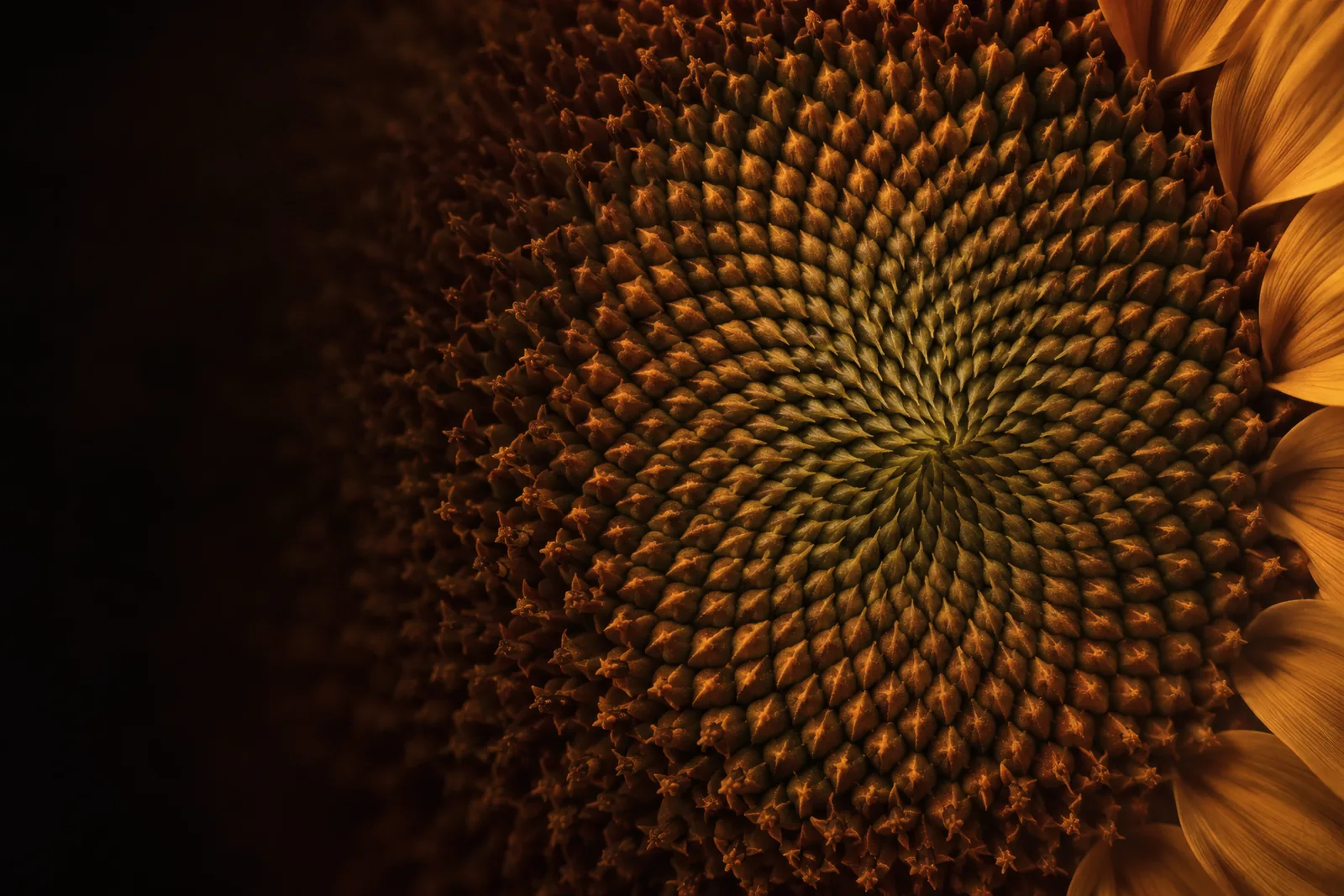
So every zome has n left-handed and n right-handed spirals: 12 each way on a 12-fold zome, 14 on a 14-fold. The count is the fold count, whatever fold count you pick; it is not a Fibonacci phyllotaxis count like a sunflower’s.
On a zome cut at level b, each spiral runs b edges from the top to the base. Seen from the axis, it swings 180° × (b − 1)/n around the building between its first edge and the base: 90° on the Capella, the Gemma and the Borealis, 80° on the Mira. A glazing scheme that follows one spiral makes a band of light that climbs a quarter turn around the room.
Where the golden ratio does and doesn’t appear
Zomes attract golden-ratio claims. Here’s where φ (phi, about 1.618) really is.
- The rhombic icosahedron. For a 5-fold polar zonohedron there is one pitch at which the star rhombi and the second-row rhombi have supplementary angles, so all 20 faces are congruent. They are golden rhombi, with diagonals in the ratio 1.618. Fedorov described it; Hart works it out. In our notation that’s n = 5 with φ = 63.43° and α = 63.43°.
- The rhombic triacontahedron. Add an axial zone to the rhombic icosahedron and you get Kepler’s rhombic triacontahedron: 30 golden rhombi, six edge directions, icosahedral symmetry. It isn’t polar.
- Zometool. The construction toy’s geometry is based on golden-section proportions, as Zometool’s own history says, because it’s built on icosahedral symmetry.
And where it isn’t:
- The rhombic dodecahedron, the 4-fold polar zonohedron, has rhombi of 70.53° with diagonals in the ratio √2, about 1.414.
- Zomes of 7 to 14 folds. Each row’s rhombus has its own diagonal ratio, set by n and alpha: on the Capella, 4.71 in the star, then 2.28, 1.45, 1.03 (nearly square), 1.23 and 1.35 at the waist. Because the angles sweep through a continuous range, a row can land near the golden shape by chance. In the family table the nearest are the 9-fold’s second row at 62.17° (diagonals 1.66) and the 13-fold’s third row at 64.08° (1.60). Neither is golden, and nothing in the design depends on it.
From angles to a buildable shell
The formulas above give a mathematical surface. Building it from 2x lumber adds three things the Zome Lab calculator and our plans handle:
- Frame depth. A strut has thickness. Our panels are framed so that their inside edges touch, and the frame grows outward from the inside face, so every panel outline, jig and strut length comes from the inside-face geometry.
- Miters and rips. Pinwheeled struts need only plain miters (the abs(90° − θ) column above). The skin is ripped at half each joint’s fold. Some miters are past a miter saw’s stop: the Capella’s star needs 66°, cut against a 45° auxiliary fence at 21°.
- Openings and the base. Doors take out a column of panels and add side walls; the base needs a plate ripped to the bottom row’s lean (19.2° on the Capella). These are where a plan earns its keep.
 Plan · Home · Cabin or small ADUCapella Zome 25A 430 sq ft zome cabin with 97% standing room.25'-8 5/8"430 sq ftfrom $59
Sources
- George Hart, The Joy of Polar Zonohedra, Bridges 2021 Proceedings: definitions, counts, surface helices, the volume-maximizing pitch, the rhombic icosahedron, and the appendix formulas for face and dihedral angles.
- George Hart, Zonohedra, Virtual Polyhedra: the umbrella-ribs construction and polar examples.
- B. L. Chilton and H. S. M. Coxeter, “Polar Zonohedra,” American Mathematical Monthly 70, no. 9 (1963): 946–951.
- Steve Baer, Zome Primer: Elements of Zonohedra Geometry, Zomeworks Corp., 1970.
- Our engine and the Capella Zome 25 cut list and build guide, for the worked checks.
Questions
Q01What is a polar zonohedron?
A polar zonohedron is a convex solid built from n equal edge vectors spaced evenly around an axis and tilted at the same angle, like the ribs of an umbrella. All its faces are rhombi with equal edges, it has two n-fold poles, and it has n(n-1) faces. A zome is the top part of one.
Q02How do you calculate the angles of a zome?
Choose the fold count n and the generator angle alpha from vertical. The rhombus in row k has the angle theta at its top where cos(theta) = cos^2(alpha) + sin^2(alpha) cos(360k/n degrees). Row 1 is the star; rows k and n-k have the same shape.
Q03What is the 287-degree rule?
It is our family rule: each zome's star-point angle times its fold count stays near 287 degrees, so each point fills about 80% of its share of the circle. In practice it holds the edges at about 53 degrees from vertical for every fold count, which keeps the crown looking the same from 7 to 14 folds.
Q04Do zomes use the golden ratio?
Not in general. The golden rhombus appears in the 5-fold rhombic icosahedron, the rhombic triacontahedron and the Zometool system. Zomes of 7 to 14 folds have rhombus shapes set by n and alpha; a row can land near the golden shape by coincidence, but none is golden.
Q05How many spirals does a zome have?
As many each way as it has folds: a 12-fold zome has 12 spirals turning left and 12 turning right. Each is a chain of equal edges that, over the full solid, makes one turn of a circular helix.