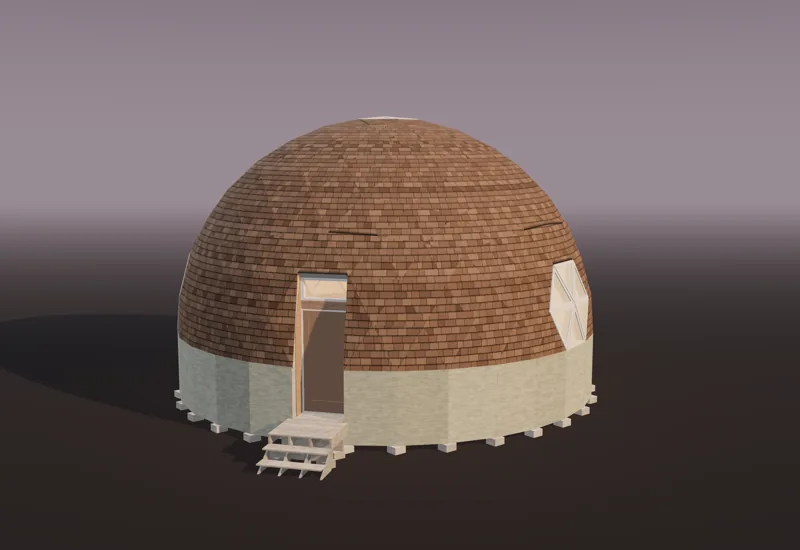
A geodesic dome is a sphere approximated with triangles; a zome is a tall, star-crowned shell of diamonds with all edges equal. At 30 feet a zome has under a third of the dome’s struts and a quarter of its panels, plus more height; the dome covers more floor with less roof and is rigid on its own.
The comparison below isn’t from brochures. Our plan line has zomes and geodesic domes at five matching sizes, framed the same way (flat 2x6 panels built on a jig, screwed together, skinned and roofed), so we can count real panels, struts, screws, sheets and dollars side by side.
The short version
| Zome | Geodesic dome | |
|---|---|---|
| Faces | Rhombi (diamonds) in rows around the axis | Triangles |
| Edge lengths | One | Several (5 to 19 in our plans) |
| What’s on a sphere | Nothing in particular | Every corner |
| Profile | Taller than half its width | A hemisphere: height equals the radius |
| Rigid without skin? | No: needs sheathing or rails | Yes |
| Parts at 30 feet (our plans) | 82 panels, 310 struts | 352 panels, 1,056 struts |
| Shell per sq ft of floor (25 to 40 ft) | about 2.4 sq ft | 1.8 to 2.0 sq ft |
| Flattest face | the star, about 37 to 39 degrees | the crown, under 2:12 on a 4V or 6V |
| Top | a star of n points | a pentagon (or hexagon) of triangles |
Where each shape comes from
A geodesic dome starts from an icosahedron. Each triangular face is split into smaller triangles (the frequency, written 2V, 3V, 4V, 6V), and the new corners are pushed out to a sphere. Walther Bauersfeld built the first for the Zeiss planetarium in Jena in the 1920s; Buckminster Fuller named, patented (US 2,682,235, 1954) and popularized it. Because every corner sits on a sphere, the struts come in several lengths, and more of them as the frequency rises. See What is a geodesic dome?
A zome starts from n equal edges spaced around a vertical axis like the ribs of an umbrella, all tilted at one angle. Diamonds fill the gaps row by row. The result is a polar zonohedron, and a zome is its top portion. Every edge is the same length and points in one of n directions. George Hart sums up the difference in The Joy of Polar Zonohedra: geodesic domes put every vertex on a sphere, while polar zonohedra keep the parallel edges and modularity of zonohedra. See What is a zome? and Zome geometry explained.
Five pairs, side by side
Each pair is a zome and a dome from our plans of about the same width. Both are framed in 2x6 on a 2- or 3-foot wall, with insulated, sheathed, roofed panels.
| Pair | Plan | Geometry | Across | Floor (sq ft) | Inside height | Panels / struts | Distinct strut cuts |
|---|---|---|---|---|---|---|---|
| 16 ft | Mira Zome 16 | 9-fold zome | 15’-6 1/2” | 155 | 12’-9 1/2” | 44 / 164 | 19 |
| Deneb Dome 16 | 3V 5/9 dome | 15’-7 13/16” | 166 | 11’-2 3/8” | 101 / 303 | 12 | |
| 22 ft | Gemma Zome 22 | 10-fold zome | 24’-2 13/16” | 360 | 19’-6 3/4” | 58 / 216 | 20 |
| Halo Dome 22 | 3V 5/9 dome | 21’-8 1/2” | 330 | 14’-10 5/16” | 97 / 291 | 12 | |
| 25 ft | Capella Zome 25 | 12-fold zome | 25’-8 5/8” | 430 | 20’-1” | 82 / 310 | 21 |
| Twilight Dome 26 | 4V dome | 25’-10 13/16” | 483 | 15’-9 1/2” | 142 / 426 | 25 | |
| 30 ft | Arcturus Zome 30 | 12-fold zome | 30’-0” | 603 | 23’-2” | 82 / 310 | 21 |
| Equinox Dome 30 | 6V dome | 31’-6 15/16” | 733 | 18’-7 1/2” | 352 / 1,056 | 27 | |
| 40 ft | Borealis Zome 40 | 14-fold zome | 40’-0” | 1,121 | 30’-3” | 111 / 427 | 22 |
| Vesper Dome 40 | 6V dome | 40’-10 15/16” | 1,247 | 23’-3 1/2” | 352 / 1,056 | 27 |
Panel counts are as built, with the panels removed or replaced at doors. “Distinct cuts” counts every different strut length-and-miter combination you set up on the saw.
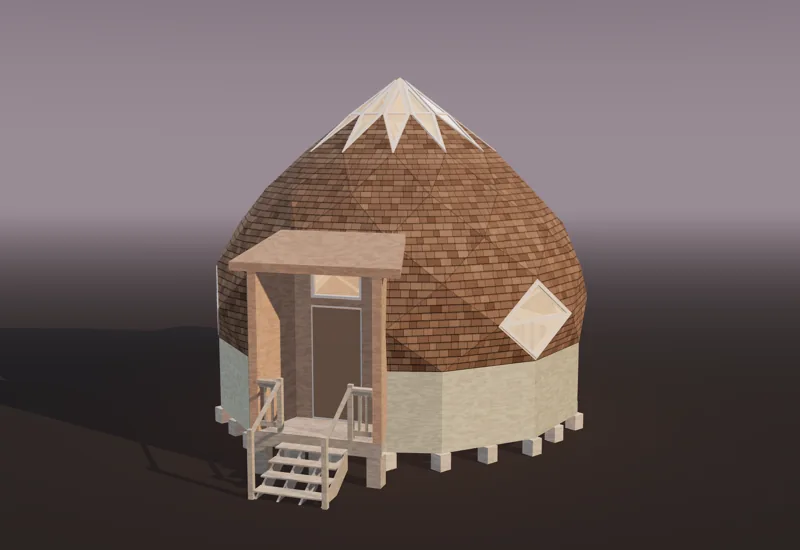 Plan · Home · Cabin or small ADUCapella Zome 25A 430 sq ft zome cabin with 97% standing room.25'-8 5/8"430 sq ftfrom $59
Parts and build time
The part count is the clearest difference, and it grows with size.
- Struts. At 25 to 26 feet the dome has 37% more struts (426 against 310). At 30 feet it has 3.4 times as many (1,056 against 310), because a 30-foot dome needs a 6V frequency to keep every skin within a 4’ x 8’ sheet. At 40 feet it’s 2.5 times (1,056 against 427).
- Panels to build, lift and fasten. 82 against 352 at 30 feet. Each panel is a jig cycle, a lift and a set of edge joints.
- Screws in the frame. Counting strut joints and panel-to-panel joints: about 1,560 for the Capella against about 2,060 for the Twilight; about 1,670 for the Arcturus against about 4,540 for the Equinox; about 2,480 for the Borealis against about 5,280 for the Vesper.
- Strut lumber. 1,741 linear feet of 2x6 for the Arcturus panels against 3,085 for the Equinox; 2,789 against 4,071 at 40 feet.
- Setups. Distinct cuts are closer: 21 for the 12-fold zome against 25 to 27 for the 4V and 6V domes. A zome has one edge length but a different miter in every row; a dome has several lengths.
Where the zome gives some back is panel size. Its diamonds are big: on the Capella, 24 skins are wider than a 4’ x 8’ sheet and go on in two strips over a nailer framed into the panel, and the larger homes piece their windows over a mullion. Big panels are also heavier to lift into place. The dome’s small triangles fit a sheet easily.
We haven’t yet published timed builds; the build diaries will report measured hours. Until then, part counts are the honest proxy: at 30 feet and up, a zome has a quarter to a third of the dome’s panels.
Headroom, floor and volume
| Pair | Standing room (6’-8” or more) | Volume, ft³ | Volume per sq ft of floor |
|---|---|---|---|
| Mira 16 / Deneb 16 | 81% / 84% | about 1,300 / about 1,200 | 8.3 / 7.5 |
| Gemma 22 / Halo 22 | 95% / 94% | about 4,800 / about 3,200 | 13.4 / 9.7 |
| Capella 25 / Twilight 26 | 97% / 88% | about 5,700 / about 5,600 | 13.2 / 11.5 |
| Arcturus 30 / Equinox 30 | not published / 94% | about 9,100 / about 9,800 | 15.1 / 13.3 |
| Borealis 40 / Vesper 40 | not published / 96% | about 21,200 / about 20,500 | 18.9 / 16.5 |
Standing room comes from our plans. Volumes are our calculation: for the zomes, the exact polyhedron above the base plus the 3-foot pony wall; for the domes, a smooth hemisphere plus its riser or knee wall, which slightly overstates them.
What the numbers say:
- Floor at a given width goes to the dome. A hemisphere’s widest point is at its base, so the floor uses the full diameter. A zome’s widest point is its waist, a little above the base, and its lower rows tuck in.
- Standing room near the walls is close. Both sit on a wall (a pony, riser or knee wall), and both lose a strip at the perimeter. The zome’s steep lower rows (the waist row is vertical) keep more of its floor at full height at 25 feet.
- Volume goes to the zome, 10 to 40 percent more per square foot of floor in these pairs. That is space for a loft, a tall room, or stack ventilation through the crown. It’s also more air to heat. Our plans cover the shell; lofts and rooms are the builder’s to design.
- Height can be a problem. Above grade, the Arcturus stands 26’-4 1/2” against 21’-0 11/16” for the Equinox, and the Borealis 33’-6 9/16” against 25’-8 11/16” for the Vesper. Many detached-ADU rules cap height between 16 and 25 feet.
Shell area, insulation and energy
Here the dome wins, and it’s geometry, not marketing. For each square foot of floor, our 25- to 40-foot zomes need about 2.4 sq ft of shell (roofed panels plus glazing). Our 26- to 40-foot domes need 1.8 to 2.0.
| Pair | Shell area, sq ft (skinned + glazed) | Shell per sq ft of floor |
|---|---|---|
| Capella 25 / Twilight 26 | 1,048 / 869 | 2.44 / 1.80 |
| Arcturus 30 / Equinox 30 | 1,454 / 1,426 | 2.41 / 1.95 |
| Borealis 40 / Vesper 40 | 2,735 / 2,427 | 2.44 / 1.95 |
More shell means more roofing, more insulation, more drywall and more surface losing heat, all per square foot of floor. Both lines fill their frames with closed-cell foam to about R-36 in 2x6 (R-47 in the 2x8 editions), so the difference is area, not assembly. Some of the zome’s extra area is the steep lower rows, which the energy code may treat as wall: on the Capella, rows 5 to 7 are 60 degrees or steeper, about 40% of the shell. For the full assembly story, see our building-science articles as they publish.
Bracing: triangles vs diamonds
A triangle of struts can’t change shape without a strut changing length. A diamond can rack like a parallelogram with every strut intact. That’s the structural difference that matters most.
- The dome is stiff as a bare frame. Skins and glazing add weather protection; the triangles carry the shape.
- The zome gets its stiffness from its skin. Plywood or OSB screwed to each diamond makes a stressed-skin panel that resists racking. Where a diamond is glazed in an otherwise skinned shell, the neighboring plywood braces the shell. Where the whole shell is glazed, as in a greenhouse, each diamond needs a level rail across its horizontal diagonal, which turns it into two triangles. When we checked a glazed 9-fold shell of plain diamonds, it had more than 20 collapse modes; with rails it stood with no help from the panes.
So the zome’s skin nailing and its rails are structural, and the plans mark them that way. This is also why online advice that “zomes need triangulating” is half right: a zome of bare struts does, and a sheathed panel zome already is braced. Either way, a home needs an engineer’s review for its site’s snow, wind and seismic loads, and a permit.
Roofing
Both shapes are convex, so neither has valleys: every joint between facets is a hip that sheds water. The difference is at the top.
- Zome. Every face of our zomes is at about 37 degrees or steeper (roughly 9:12); the flattest is the star. Shingles work on every face, and the steepest rows near the waist shed water like walls.
- Dome. A hemisphere’s facets flatten toward the crown. The top facets of a 4V dome slope about 9 degrees and a 6V dome’s about 6 degrees, both under the 2:12 minimum the IRC sets for asphalt shingles. On any hemisphere about 5% of the shell is flatter than 4:12, where shingles need a double underlayment. Our dome homes glaze the top five panels as a crown, which takes that flattest zone out of the roofing problem.
Roofing quantity, with waste, comes out close despite the zome’s extra area, because the zomes carry more glass: 10 squares for both the Capella and the Twilight, 14 for the Arcturus against 16 for the Equinox, 27 for the Borealis against 26 for the Vesper.
Leaks on either shape come from flashing, seams and penetrations, not the geometry. See Do geodesic domes leak?
Windows and doors
Neither shape has a plumb, rectangular wall to drop a door into, so both need framing at every opening.
- Doors in a zome. Our zome homes take out a column of panels at the door and frame a door wall between two side walls that carry an awning over the landing. The door-head strut bears on built-up posts with a strap tie and hold-downs. On a small zome the side walls converge, so the clear width has to be checked; our Mira and Altair carry their heads without posts to keep a 35-inch clear way in.
- Doors in a dome. Our domes cut a notch: remove a set of triangles around a base corner and fit flat cheeks and a level head, then a framed door wall. The notch width is set by the frequency and radius, which is why the Equinox’s radius was chosen to fit a 36-inch door.
- Windows. A zome’s windows are diamonds, and its vertical waist row takes upright ones; the star makes a natural skylight. A dome’s windows are triangles, or hexagons and pentagons of several triangles, and its crown is the skylight. Glazed diamonds over a 4’ x 8’ sheet are pieced over a mullion.
Cost
We priced the shells of four pairs with the same unit prices: one building-supply chain’s web prices on 2026-11-15, the plans’ own quantities, closed-cell foam at the price of a DIY kit, and an estimate for 1/4-inch polycarbonate. The zome cost guide gives every assumption. “Shell” here means panel frames, skins, roofing, glazing and the frame insulation; base walls, floors, doors and fasteners are left out of both.
| Pair | Zome shell | per sq ft of floor | Dome shell | per sq ft of floor |
|---|---|---|---|---|
| Gemma 22 / Halo 22 | about $13,100 | $36 | about $11,100 | $34 |
| Capella 25 / Twilight 26 | about $14,200 | $33 | about $13,600 | $28 |
| Arcturus 30 / Equinox 30 | about $19,700 | $33 | about $21,000 | $29 |
| Borealis 40 / Vesper 40 | about $36,300 | $32 | about $34,400 | $28 |
Per square foot of floor, the dome shells come in 8 to 15 percent cheaper in materials, because they cover each square foot of floor with less shell. Two cautions: our domes glaze with two sheets per panel and our zomes with one, and the zomes carry more glass, so glazing choices move these numbers. Foam is the biggest single line in every shell, roughly half.
Labor runs the other way. A zome has a third to a quarter of the panels at 30 feet and up. If you’re paying a crew, fewer, larger panels can outweigh a few thousand dollars of materials; if you’re building it yourself, the dome’s smaller parts are easier to handle alone. For dome budgets, see How much does a dome home cost?
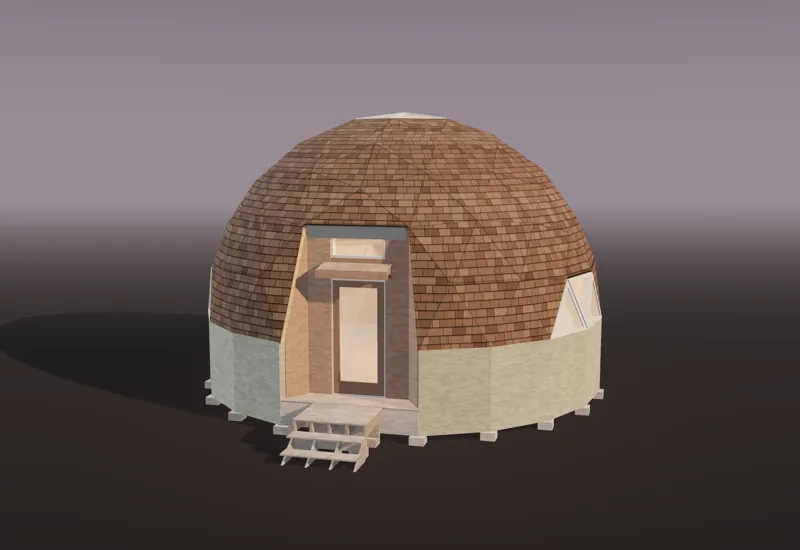 Plan · Home · Cabin or small ADUTwilight Dome 26A 483 sq ft 4V dome cabin with a door cut round a five-way corner.25'-10 13/16"483 sq ftfrom $59
Looks
This is the part people actually decide on, so it’s worth saying plainly.
- A zome reads as a tall, pointed form with a star at the top and spirals climbing both ways around it, n each way. It looks like a seed head or a crown. It suits sites where height is welcome and where the building is meant to be seen.
- A geodesic dome reads as a low, even sphere of triangles. It’s the more familiar shape, it sits lower in a landscape, and it carries the Fuller-era associations.
Which should you build?
Build a zome if:
- you want the most building for the fewest parts, and expect to pay for labor or to work with a small crew;
- you want height inside, for a loft, a tall room, or a crown vent;
- you want shingles to work on every face;
- the star and the spirals are the reason you’re doing this.
Build a geodesic dome if:
- you want the most floor for the least roof and insulation per square foot;
- you’re under a height limit, such as many ADU rules;
- you want a frame that’s rigid before it’s skinned, as in an all-glass greenhouse without rails;
- you’d rather handle many small, light panels than fewer big ones.
For greenhouses specifically: a dome needs no rails and has less glass to lose heat through per square foot of beds; a zome needs a rail in every diamond but has steep sides that shed snow and a tall crown for venting. Compare Zome greenhouse and Dome greenhouse.
If you’re undecided, the Capella Zome 25 and Twilight Dome 26 are our closest pair: the same width within about 2 inches, 430 and 483 sq ft, 310 and 426 struts.
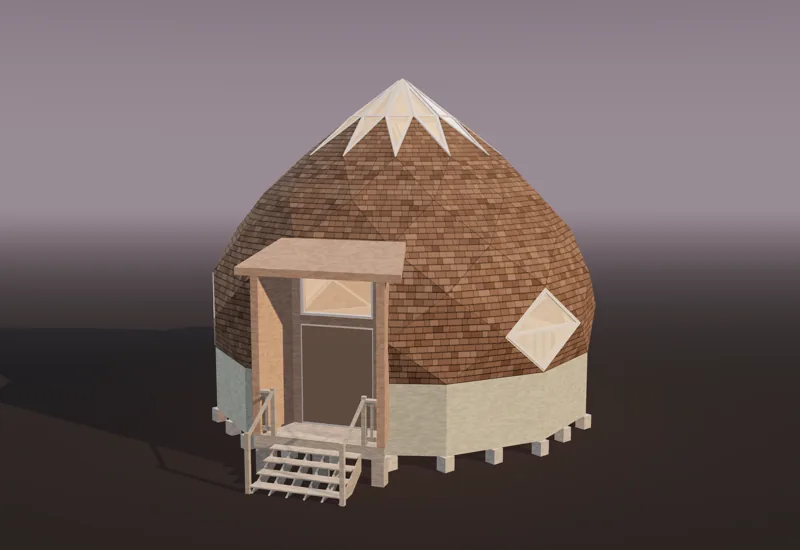 Plan · Home · ADU or small homeArcturus Zome 30A 30-foot zome home: 603 sq ft, a back door, a bedroom’s worth of room.30'-3 11/16"603 sq ftfrom $59
Sources
- Our plans: build guides, cut lists and materials lists for every plan named above.
- George Hart, The Joy of Polar Zonohedra, Bridges 2021.
- R. Buckminster Fuller, US Patent 2,682,235, Building Construction, 1954.
- International Code Council, 2021 International Residential Code, section R905 (roof coverings).
Questions
Q01Is a zome easier to build than a geodesic dome?
At the same width a zome has far fewer parts: 82 panels and 310 struts at 30 feet in our plans, against 352 panels and 1,056 struts for a 6V geodesic dome. Every zome strut is one length. The catch is that zome panels are bigger, and a zome needs its sheathing or rails to stand stiff.
Q02Which has more usable space, a zome or a dome?
At about the same width, our hemispherical domes have slightly more floor, while our zomes have more height and volume. Standing room near the walls is similar: 97% of the Capella Zome 25's floor has 6 feet 8 inches of headroom, against 88% for the Twilight Dome 26.
Q03Which is cheaper, a zome or a geodesic dome?
In shell materials, our domes cost about 8 to 15% less per square foot of floor, because a hemisphere covers each square foot of floor with less shell. Zomes need fewer parts, which saves labor, so the total depends on who does the work.
Q04Why does a zome need sheathing or rails when a dome doesn't?
A triangle can't change shape unless a side changes length, so a triangulated dome frame is stiff by itself. A rhombus can lean over like a parallelogram with every side unchanged. A zome gets its stiffness from structural sheathing on each diamond, or from a rail across each diamond that splits it into two triangles.
Q05Are zomes and geodesic domes the same thing?
No. A geodesic dome subdivides an icosahedron into triangles whose corners lie on a sphere. A zome is cut from a polar zonohedron: rhombi with equal edges in rows around a vertical axis. They look related because both are faceted domes.