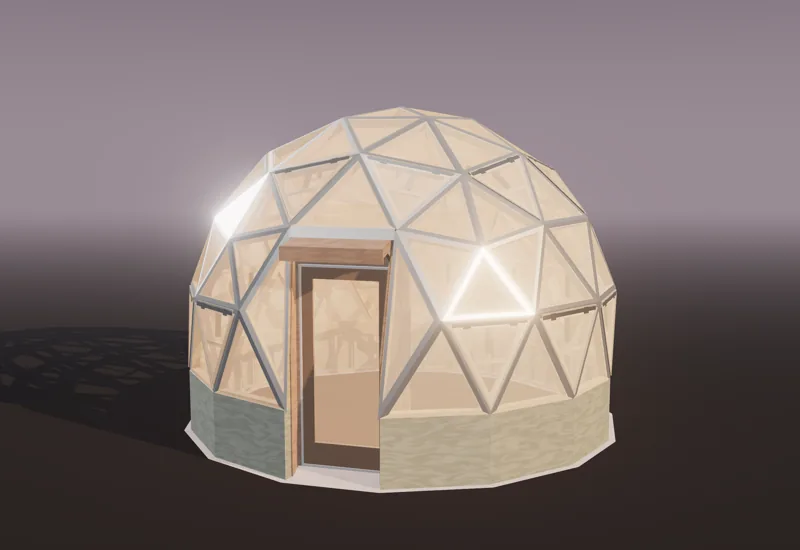
A geodesic dome is a part of a sphere built from a network of triangles whose corners all lie on that sphere. Most start from an icosahedron, a 20-faced solid, whose faces are divided into smaller triangles and pushed out to the sphere. Triangles can’t change shape without a member changing length, so the shell is stiff and light for the space it covers.
That one-paragraph answer covers the shape. The rest of this guide covers what builders need: where the idea came from, what “frequency” and “chord factor” mean, strut and panel counts for the common domes, why odd frequencies don’t sit level and how Kruschke’s geometry fixes it, how hub-and-strut domes differ from panelized ones, and an honest list of what domes do well and badly. Every table of lengths and counts below was computed for this page and checked against published tables.
What a geodesic dome is
Three ideas sit inside that definition.
- Triangles. A triangle is the only polygon that can’t rack. Push on a square frame and it folds into a rhombus; push on a triangle and one of its sides has to stretch or shorten. A shell made only of triangles carries load by tension and compression in its members, not by bending at the joints.
- A sphere. Every corner (vertex) sits on one sphere. For a given volume a sphere has the least surface, so a dome encloses a lot of air for its skin.
- A regular starting solid. Builders almost always start from the icosahedron, which already has 20 equilateral triangles with all 12 corners on a sphere. Subdividing it gives a rounder and rounder approximation while keeping the five-fold and three-fold symmetry that keeps the number of different parts small.
A geodesic dome is different from a zome, which is built from rhombic (diamond) faces arranged in spiral rows around a vertical axis. The two are compared in detail in zome vs geodesic dome, and the zome is covered in what is a zome.
Who invented the geodesic dome
The short answer is Walther Bauersfeld, not Buckminster Fuller.
- Jena, 1920s. Bauersfeld, chief engineer at Carl Zeiss in Jena, needed a hemispherical screen for the projection planetarium Zeiss was developing. He designed a dome framed as a subdivided icosahedron. A test dome went up on the roof of the Zeiss works (sources date it 1922 or 1923), and the larger Jena planetarium, nicknamed “the Wonder of Jena”, opened to the public on July 18, 1926 (Wikipedia: Geodesic dome; Wikipedia: Walther Bauersfeld).
- Black Mountain College, 1948-49. Buckminster Fuller arrived at the same geometry independently in experiments with students including Kenneth Snelson, and coined the term “geodesic” for it.
- The patent, 1954. Fuller filed US Patent 2,682,235, titled simply “Building construction,” on December 12, 1951; it was granted on June 29, 1954 (Google Patents).
- The boom. Fuller’s company and licensees built domes for industry, the military and exhibitions. The Climatron at the Missouri Botanical Garden, opened in 1960, was the first geodesic dome used as a conservatory (Missouri Botanical Garden). The US Pavilion at Expo 67 in Montreal survives as the frame of the Biosphère, and Epcot’s Spaceship Earth (1982) is a full geodesic sphere.
Fuller didn’t invent the dome, but he did the work that made it a building type: the name, the patent, the mathematics in print, and decades of promotion. Lloyd Kahn, who published Domebook in the early 1970s, has written a short piece arguing the same point (Lloyd Kahn). The 1960s and 70s then brought the hand-built home dome, with all the lessons that came with it; those are covered in do geodesic domes leak?.
How a geodesic dome is made from an icosahedron
Stand an icosahedron on one of its corners. It then has a corner at the top, a ring of five corners below it, a second ring of five turned 36 degrees, and a corner at the bottom. Its 20 faces fall into three bands: a cap of five faces at the top, a belt of ten round the middle, and a cap of five at the bottom.
To make a geodesic sphere:
- Divide each edge of each face into V equal parts and draw lines parallel to the face’s sides. Each big triangle becomes V × V small triangles.
- Push every new corner straight out from the centre until it touches the sphere.
- Connect the corners. The flat triangles are now slightly different sizes, because the points near the middle of each big face had further to travel than the points near its corners.
That last step is why a geodesic dome needs several strut lengths, and why the lengths are given as chord factors (below) rather than as one number.
Frequency: what 1V to 8V means
Frequency, written V (some books use ν), is the number of parts each icosahedron edge is divided into. A 1V sphere is the icosahedron itself. A 2V sphere has 4 small triangles per face, a 3V has 9, a 4V has 16.
The counts follow simple rules for the whole sphere: 20V² faces, 30V² edges (struts) and 10V² + 2 vertices (hubs). The number of different strut lengths and triangle shapes doesn’t follow a rule as simple; we counted them.
| Frequency | Triangles (sphere) | Struts | Vertices | Strut lengths | Triangle shapes |
|---|---|---|---|---|---|
| 1V | 20 | 30 | 12 | 1 | 1 |
| 2V | 80 | 120 | 42 | 2 | 2 |
| 3V | 180 | 270 | 92 | 3 | 2 |
| 4V | 320 | 480 | 162 | 6 | 5 |
| 5V | 500 | 750 | 252 | 9 | 7 |
| 6V | 720 | 1,080 | 362 | 9 | 6 |
| 7V | 980 | 1,470 | 492 | 16 | 12 |
| 8V | 1,280 | 1,920 | 642 | 20 | 15 |
Class I, method 1 subdivision of an icosahedron, computed for this page. The 3V figures match the 92 vertices, 270 edges and 180 faces given for the 3V geodesic polyhedron by Wikipedia: Geodesic polyhedron.
What frequency buys you:
- Roundness. Higher frequency means flatter folds between neighbouring triangles. On our 3V dome the panels meet at 12 to 14 degrees; on our 6V, at 4.6 to 7.2 degrees.
- Smaller parts. At a given diameter, each step up shortens the struts. That matters most when each triangle has to be skinned from one sheet of plywood.
- More parts, more labour. The count grows with the square of the frequency. A 6V hemisphere has 360 triangles against a 3V’s 105.
Class I, Class II, and why calculators disagree
“Frequency” alone doesn’t fix the geometry. Two further choices change the strut lengths.
The class: which way the grid runs.
- Class I (“alternate”) draws the small triangles with lines parallel to the big face’s edges, as described above. It’s the common choice for buildings because whole rows of struts line up and even frequencies cut cleanly at the equator.
- Class II (“triacon”) runs the grid at right angles to the big face’s edges. The pattern looks different and the struts are numbered differently.
- Class III runs the grid at a skew, so the result comes in left- and right-handed versions. It’s rare in buildings.
Wikipedia’s geodesic polyhedron page gives the formal notation: Class I is written with one index zero, Class II with the two indices equal, Class III with them unequal.
The method: how points are spaced before they’re projected. “Method 1” spaces the points evenly on the flat face, which is what we computed. Other methods space them evenly along arcs, or adjust them to equalize lengths, or, in Kruschke’s case, to level the base. Each gives slightly different chord factors for the “same” frequency. If two calculators disagree in the third decimal, this is usually why, and the Geodesic Help group has years of threads about exactly that. Pick one method and use it for every part of the dome.
Chord factors: the tables for 2V, 3V and 4V
A chord factor is a strut’s length divided by the sphere’s radius. Multiply it by your radius and you have the vertex-to-vertex length of that strut: the straight line between two corner points on the sphere. Hub domes then subtract the hub’s offset at each end, and panel domes subtract or add for the frame depth, but the chord is the geometry everything starts from.
We computed these by subdividing an icosahedron in Python exactly as described above (Class I, method 1) and measuring every edge. They match the published chord charts on Domerama to all five decimal places, and the strut and hub counts match Desert Domes’ calculators. Sources letter the struts differently (Domerama calls the 2V’s 0.61803 strut “A”), so the table lists them shortest first and gives the count, which doesn’t depend on lettering.
| Dome | Strut | Chord factor | Count | Length at a 10’ radius (20’ dome) |
|---|---|---|---|---|
| 2V hemisphere | A | 0.54653 | 30 | 5’-5 9/16” (1,666 mm) |
| B | 0.61803 | 35 | 6’-2 3/16” (1,884 mm) | |
| 3V 4/9 (“3/8”) | A | 0.34862 | 30 | 3’-5 13/16” (1,063 mm) |
| B | 0.40355 | 40 | 4’-0 7/16” (1,230 mm) | |
| C | 0.41241 | 50 | 4’-1 1/2” (1,257 mm) | |
| 3V 5/9 (“5/8”) | A | 0.34862 | 30 | 3’-5 13/16” (1,063 mm) |
| B | 0.40355 | 55 | 4’-0 7/16” (1,230 mm) | |
| C | 0.41241 | 80 | 4’-1 1/2” (1,257 mm) | |
| 4V hemisphere | A | 0.25318 | 30 | 2’-6 3/8” (772 mm) |
| B | 0.29453 | 60 | 2’-11 5/16” (898 mm) | |
| C | 0.29524 | 30 | 2’-11 7/16” (900 mm) | |
| D | 0.29859 | 30 | 2’-11 13/16” (910 mm) | |
| E | 0.31287 | 70 | 3’-1 9/16” (954 mm) | |
| F | 0.32492 | 30 | 3’-3” (990 mm) |
Lengths are vertex to vertex, rounded to the nearest 1/16”. The 4V’s B, C and D struts differ by less than half an inch at this size: label them, because they’re easy to mix up.
A worked example: you want a 2V greenhouse frame 16 feet across, so the radius is 96 inches. The short struts are 0.54653 × 96 = 52.47 inches and the long ones 0.61803 × 96 = 59.33 inches, vertex to vertex. If your hubs put each strut end 1 1/2 inches short of the vertex, cut them 3 inches shorter: 49 7/16” and 56 5/16”. Our geodesic dome calculator does this arithmetic for any radius.
Strut, hub and panel counts for common domes
A dome is a slice of the sphere, so its counts are smaller than the sphere’s, and the base ring changes them further. These are the counts for a hub-and-strut frame, and the panel count is the number of triangles.
| Dome | Rows kept | Triangles | Struts | Hubs (4-way / 5-way / 6-way) | Strut lengths | Triangle shapes | Base sides |
|---|---|---|---|---|---|---|---|
| 2V hemisphere | 3 of 6 | 40 | 65 | 26 (10 / 6 / 10) | 2 | 2 | 10 |
| 3V 4/9 (“3/8”) | 4 of 9 | 75 | 120 | 46 (15 / 6 / 25) | 3 | 2 | 15 |
| 3V 5/9 (“5/8”) | 5 of 9 | 105 | 165 | 61 (15 / 6 / 40) | 3 | 2 | 15 |
| 3V 5/9 Kruschke | 5 of 9 | 105 | 165 | 61 (15 / 6 / 40) | 4 | 3 | 15, level |
| 4V hemisphere | 6 of 12 | 160 | 250 | 91 (20 / 6 / 65) | 6 | 5 | 20 |
| 6V hemisphere | 9 of 18 | 360 | 555 | 196 (30 / 6 / 160) | 9 | 6 | 30 |
| 8V hemisphere | 12 of 24 | 640 | 980 | 341 (40 / 6 / 295) | 20 | 15 | 40 |
Computed for this page; Kruschke figures from our dome engine. Rows are rows of triangles counted down from the top.
A panelized dome turns these numbers around. It has no hubs at all. Each triangle is framed on its own with three members, so a shared edge has two frame members side by side, one from each panel: a 3V 5/9 needs 105 × 3 = 315 frame pieces instead of 165 struts and 61 hubs. Our Deneb Dome 16 uses 303 of them, because its door takes out six triangles and puts in two flat cheek panels.
Hemisphere, 3/8 or 5/8: where to cut the sphere
Even frequencies cut cleanly
At 2V, 4V, 6V and 8V, the Class I sphere has a ring of corners exactly on the equator, so the hemisphere stands on a level polygon: 10 sides at 2V, 20 at 4V, 30 at 6V, 40 at 8V. That’s the main practical reason even frequencies are popular. The catch is that a hemisphere’s bottom row of triangles leans inward slightly and the walls start curving in right above the base, which costs headroom near the edge. Most dome homes therefore stand on a riser wall (also called a knee or pony wall) 2 to 4 feet tall.
Odd frequencies don’t
A 3V sphere has no ring of corners on the equator. Builders cut it after 4 of its 9 rows of triangles, a low dome nicknamed the “3/8”, or after 5 rows, the taller “5/8” (Domerama explains that the real fractions are 4/9 and 5/9). Either way, in method 1 geometry the base corners are not level. We computed them: of the 15 base corners, 10 stand at one height and 5 at another, 1.6% of the radius apart.
| Dome size (radius) | Base corners out of level |
|---|---|
| 12’ dome (6’ radius) | 1 1/8” (29 mm) |
| 16’ dome (8’ radius) | 1 1/2” (39 mm) |
| 22’ dome (11’ radius) | 2 1/8” (54 mm) |
| 30’ dome (15’ radius) | 2 7/8” (73 mm) |
Computed from the 3V 5/9 method 1 geometry. The 5V has the same problem at about 0.7% of the radius: 1 1/4” on our 30-foot size.
An inch and a half doesn’t sound like much until you try to sit 15 corners on a level ring beam or slab. The usual fixes are shims, a stepped foundation, re-cut bottom struts, or giving up some base corners. Domerama lists those and calls the last option, a different geometry, the only practical one.
Kruschke’s level-base 3V
That geometry is Kruschke’s. David Kruschke published it in 1972 (per Domerama). Instead of dividing each icosahedron edge into equal thirds, it slides the division points along each edge so that the corners of the two lowest rows come out level. The base is a flat 15-sided ring.
The cost is one extra strut length. Our engine derives the split rather than looking it up: each icosahedron edge (a 63.43-degree arc) is split 18.98 degrees from its end, which puts the new points at the same 10.81-degree latitude as the centres of the belt faces. That reproduces the published Kruschke chord factors to nine places:
| 3V 5/9 Kruschke strut | Chord factor | Count | Length at a 10’ radius |
|---|---|---|---|
| A | 0.32971 | 30 | 3’-3 9/16” (1,005 mm) |
| B | 0.38229 | 35 | 3’-9 7/8” (1,165 mm) |
| C | 0.42149 | 80 | 4’-2 9/16” (1,285 mm) |
| D | 0.44106 | 20 | 4’-4 15/16” (1,344 mm) |
The counts (30, 35, 80 and 20, 165 in all) match Domerama’s Kruschke 5/8 calculator. The dome stands 1.188 times its radius tall, about 59% of the sphere’s full height, and needs only three triangle shapes.
We use it on every 3V we sell: the Solstice Dome 16 and 22 greenhouses, the Deneb Dome 16 glamping pod and the Halo Dome 22 tiny home all stand on a level 15-sided base.
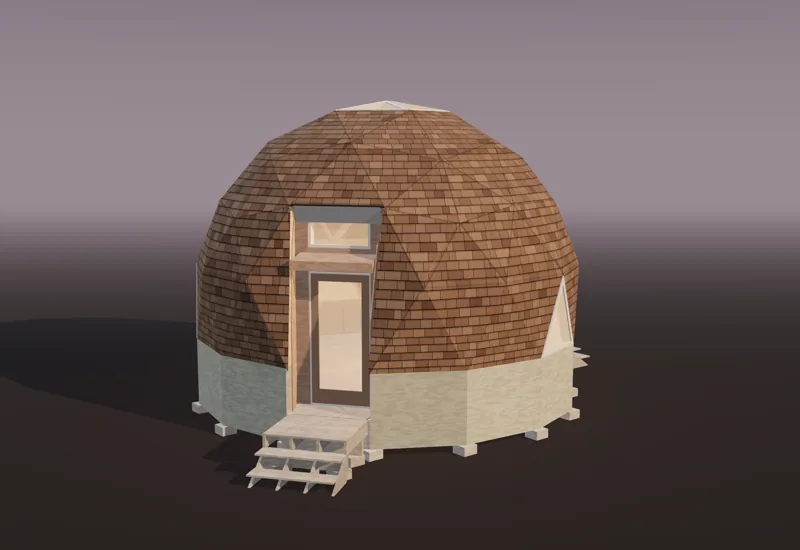 Plan · Home · Tiny home or ADUHalo Dome 22A 330 sq ft geodesic tiny home with doors and windows every 72°.21'-8 1/2"330 sq ftfrom $59
Hub-and-strut domes vs panelized domes
There are two ways to turn the geometry into a building.
Hub and strut. Every edge is one strut and every vertex is one hub: a steel plate, a flattened and bolted pipe end, a pipe connector or a proprietary fitting. The frame goes up first, and then it’s covered: sheathing triangles nailed over the frame, fabric, or glazing. This is how most kits work and how temporary and fabric domes are built.
Panelized (hubless). Each triangle is framed flat as its own panel, on a jig, then the panels are bolted or screwed edge to edge. The frame member depth becomes the insulation depth, and each panel can be skinned on the ground. There are no hubs to buy or fabricate, but every panel’s edges need the right angle cut so neighbours meet.
We build the second way. The trade-offs (accuracy, tools, cost, weather-tightness, insulation depth, structure, speed) are laid out in hubs vs hubless panels.
Which frequency for which dome
Textbooks pick frequency for roundness. Builders pick it for part size. If every triangle is skinned from one 4’ × 8’ sheet, as all of ours are, the panel size sets an upper limit on the dome’s radius for each frequency. This is what we found building our line in 2x6 timber panels:
| Dome | Frequency | Across | Why that frequency |
|---|---|---|---|
| Solstice Dome 12 | 2V hemisphere | 12’ | Few, large parts; fine for a greenhouse frame |
| Deneb Dome 16, Solstice Dome 16 | 3V 5/9 Kruschke | 15’-7 13/16” to 16’ | Level base, three panel shapes |
| Halo Dome 22, Solstice Dome 22 | 3V 5/9 Kruschke | 21’-8 1/2” to 22’ | At the Halo’s first 10’-10” radius, 34 of 89 skins were up to 13/16” too wide for a sheet; at 10’-7” every skin fits |
| Twilight Dome 26 | 4V hemisphere | 25’-10 13/16” | Five panel shapes; widest skin 3’-7 13/16” |
| Equinox 30, Celeste 35, Vesper 40 | 6V hemisphere | 31’-7” to 40’-11” | On a 4V at 30’, 34 of 128 skins outgrow a sheet; the 5V’s base is 1 1/4” off level; the 6V’s widest skin is 2’-11 1/2” at 30’ |
| Firmament Dome 45 | 8V hemisphere | 45’-11” | Past 40’, a 6V’s skins and door jambs run out |
Rule of thumb for panel domes: keep the longest strut under about 4 feet and check the widest triangle against your sheet, not the other way round. For hub domes with fabric or glazing, larger triangles are fine and lower frequency saves hubs.
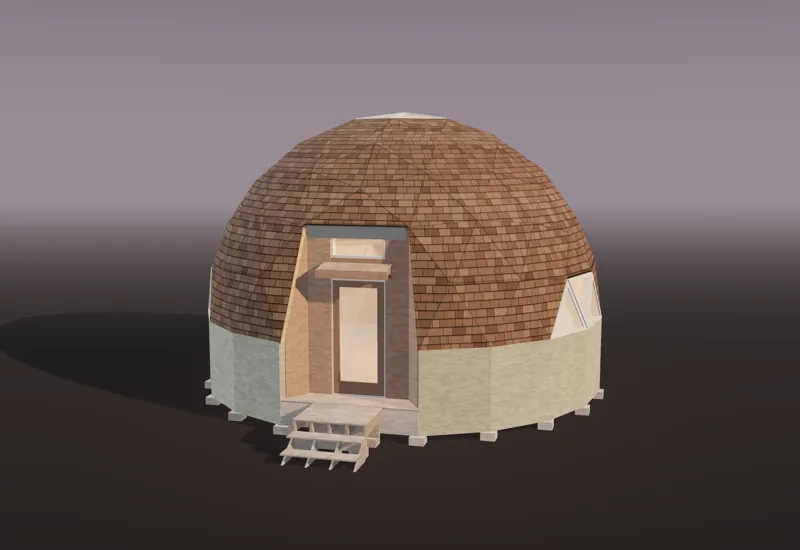 Plan · Home · Cabin or small ADUTwilight Dome 26A 483 sq ft 4V dome cabin with a door cut round a five-way corner.25'-10 13/16"483 sq ftfrom $59
What geodesic domes are used for
- Homes and cabins. The 1970s owner-builder dome is the image most people have. Today’s versions are kit homes, plan-built timber homes and glamping pods.
- Greenhouses. The shape sheds snow, resists wind and lets light in from every direction. See our dome greenhouse guide.
- Planetariums, conservatories and pavilions. From Jena’s planetarium to the Climatron and Expo 67, the dome’s clear span with no interior columns is the point.
- Temporary shelters, event and glamping tents. Hub-and-strut frames with fabric skins go up and come down quickly.
- Playground climbers and garden trellises. The same geometry at small scale.
Pros and cons, honestly
What domes do well
- Clear span. No interior posts or bearing walls. You can put rooms anywhere, or none.
- Strength for the material. A triangulated shell spreads load through the whole frame. Our Twilight Dome 26’s hardest-loaded strut, a door jamb, runs at 61% of its buckling load under the design checks; the rest of the shell carries far less.
- Less skin per floor area. A hemisphere’s shell is exactly twice the area of the circle it covers, which is low for the volume enclosed. Whether that saves energy depends on insulation and air sealing more than geometry; we’ll test the claim with our own numbers in a separate study.
- Repetition. A 4V hemisphere is 160 triangles of only five shapes. That suits jig-built panels.
What domes do badly
- Seams. A dome roof is all seams. Our 6V Equinox shell has about 1,600 feet of panel joints over about 1,465 square feet of shell. Roofing has to be detailed for that, and near the top the facets are shallow: the top pentagon of a 6V sits at about 1.2 in 12. This is why domes got their reputation for leaking; how to avoid it is in do geodesic domes leak?.
- Curved and sloped walls. Furniture, cabinets and stairs are made for vertical walls. A riser wall helps: on our Twilight 26, 427 of its 483 square feet have 6’-8” of headroom; on the Equinox 30, 690 of 733.
- Doors and windows. Standard rectangles don’t fit triangles. Every door needs a framed notch or a dormer; we cut a notch under a corner and frame a flat door wall inside it.
- Cutting labour. More parts and more angled cuts than a box. The 6V Equinox has 1,056 panel members against the 4V Twilight’s 426.
- Permits, insurance, financing and resale. Domes are legal in most places, but appraisers find few comparables and some insurers are unfamiliar with them. Budget time for it, and confirm with your building department before you buy plans or a kit.
- Sound. Hard curved surfaces focus sound. Soft finishes and furniture break it up.
Our dome plans
Every Starcrown dome is framed one triangle at a time on a flat jig from stock lumber, skinned from one 4’ × 8’ sheet per panel, and bolted panel to panel: no hubs. The plans cover the shell (frame, skin, glazed crown, base, floor platform, doors, windows and steps); what goes inside is yours.
- Homes: Deneb Dome 16 (166 sq ft), Halo Dome 22 (330), Twilight Dome 26 (483), Equinox Dome 30 (733), Celeste Dome 35 (901), Vesper Dome 40 (1,247) and Firmament Dome 45 (1,584). See all home plans.
- Greenhouses: Solstice Dome 12, 16, 22 and 30. See all greenhouse plans.
Homes need a building permit and, almost always, an engineer’s review for your site’s snow, wind and seismic loads. Our structural checks are a starting point, not a substitute; confirm with your building department.
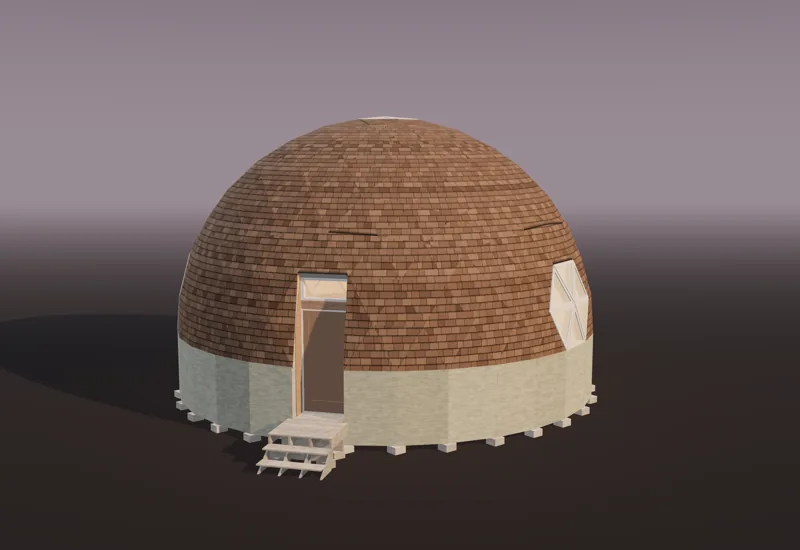 Plan · Home · ADU or small homeEquinox Dome 30A 733 sq ft geodesic dome home, every skin under three feet wide.31'-6 15/16"733 sq ftfrom $59
Sources
- Wikipedia: Geodesic dome and Walther Bauersfeld (history, dates)
- US Patent 2,682,235, Building construction (R. Buckminster Fuller, filed 1951, granted 1954)
- Missouri Botanical Garden: the Climatron
- Lloyd Kahn: Buckminster Fuller did not invent the geodesic dome
- Wikipedia: Geodesic polyhedron (classes, notation, 3V counts)
- Domerama: chord factor charts, odd-frequency domes and the flat base, 3V Kruschke flat-base calculator
- Desert Domes: 3V and 4V calculators (strut and connector counts)
- Starcrown dome engine: chord factors, counts, base levels, facet slopes and seam lengths computed 2026-11-15
Questions
Q01Who invented the geodesic dome?
Walther Bauersfeld, chief engineer at Carl Zeiss in Jena, built the first one for a planetarium projector in the early 1920s; the Jena planetarium opened in 1926. Buckminster Fuller worked out the idea independently in 1948-49, named it, patented it in 1954 and made it famous.
Q02What does 3V or 4V mean on a geodesic dome?
V is the frequency: how many parts each edge of the starting icosahedron is divided into. A 3V dome splits each edge in three, so each of the 20 big faces becomes 9 small triangles. Higher frequency means more, smaller triangles, a rounder shape and more parts.
Q03Does a 3V geodesic dome sit level?
Not in the usual Class I method 1 geometry: the 15 base corners stand at two heights, about 1.6% of the radius apart. The Kruschke version moves the subdivision points so the base ring is level, at the cost of a fourth strut length.
Q04What frequency is best for a dome home?
It depends on size and how you frame it. For flat timber panels skinned from 4x8 sheets, we use a 3V up to about 22 feet across, a 4V at 26 feet, a 6V from 30 to 40 feet and an 8V above that, because each panel's skin has to fit on one sheet.
Q05How many struts does a geodesic dome have?
A 2V hemisphere has 65 struts and 26 hubs, a 3V 5/8 has 165 struts and 61 hubs, and a 4V hemisphere has 250 struts and 91 hubs. A panelized dome has no hubs; each triangle gets its own three frame members instead.