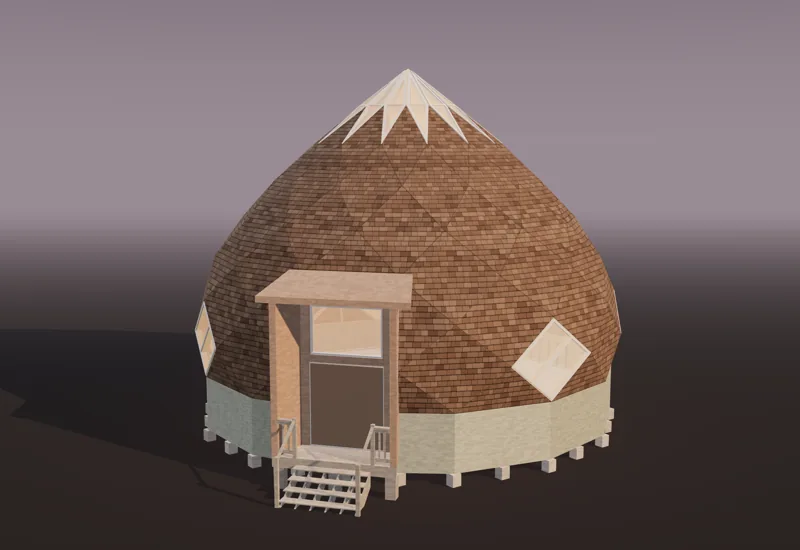
Borealis 40 · 14-fold · 39'-5 1/8" across
Zome Lab
Zome calculator
Every zome is cut from a polar zonohedron. Start from one of our shells, then bend it: the 3D, the numbers and the shop drawings follow.
Start from a shell
- Shell surface
- 2,683 sq ft
- Panel shapes (jigs)
- 8
- Diamonds
- 98
- Base triangles
- 14
- Struts, shared edges
- 224
- Struts, framed per panel
- 434
- Tilt of each vector, α
- 52.48°
- Star check, φ × n
- 20.33° × 14 = 284.6°
Jig sheet · live
One row, one jig.
A zome needs only one panel shape per row, so the Borealis 40, cut at row 8, is framed on 8 jigs. Here is each one at true proportion with its angles, edge and diagonals. The sheet redraws as you change the zome.
A Front elevation
B Plan, from above
C Panel jigs, one per row, crown to base
D Panel schedule
| Row | Panel | Qty | Top | Side | Edge | Diagonals |
|---|---|---|---|---|---|---|
| 01 | Star | 14 | 20.33° | 159.67° | 5'-6 3/8" | 10'-10 11/16" × 1'-11 7/16" |
| 02 | Diamond | 14 | 40.26° | 139.74° | 5'-6 3/8" | 10'-4 5/8" × 3'-9 11/16" |
| 03 | Diamond | 14 | 59.27° | 120.73° | 5'-6 3/8" | 9'-7 3/8" × 5'-5 5/8" |
| 04 | Diamond | 14 | 76.64° | 103.36° | 5'-6 3/8" | 8'-8 1/8" × 6'-10 5/16" |
| 05 | Diamond | 14 | 91.22° | 88.78° | 5'-6 3/8" | 7'-8 7/8" × 7'-10 7/8" |
| 06 | Diamond | 14 | 101.29° | 78.71° | 5'-6 3/8" | 7'-0 3/16" × 8'-6 5/8" |
| 07 | Diamond | 14 | 104.95° | 75.05° | 5'-6 3/8" | 6'-8 7/8" × 8'-9 5/16" |
| 08 | Half-diamond | 14 | 101.29° | 39.36° | 5'-6 3/8" | 8'-6 5/8" × 3'-6 1/16" h |
The maths
How the Zome Lab works
Every shell here is cut from one solid, a polar zonohedron. Four ideas build it, and all four are running on your zome right now.
cos φ = cos²α + sin²α · cos(2π/n)
The star angle φ fixes the tilt α. Your shell: n = 14, φ = 20.33°, α = 52.48°
-
01
n equal vectors, one tilt
Take n struts of the same length L, all tilted the same angle α from straight down and spaced 360°/n apart around the axis. Yours: 14 of them at α = 52.48°.
-
02
Add them up
Start at the apex and add neighbouring vectors: every vertex is a running sum, P(i,k) = vi + vi+1 + … + vi+k−1. Ring k sits k·L·cos α below the apex on a circle of radius L·sin α·sin(πk/n)/sin(π/n), widest at k = n/2.
-
03
One rhombus per row
Each face is spanned by two vectors k apart, so every panel in row k is the same rhombus, with top angle cos θk = cos²α + sin²α·cos(2πk/n). Row 1 is the star, θ1 = φ. Cut level through a ring, the base row, and the last diamonds halve into triangles.
-
04
The 287° family rule
At the apex n star points meet. Laid flat they would fill 360°; on the zome they fill n·φ, and the shortfall lifts the crown to a point. Starcrown zomes keep n·φ close to 287°, the same 73° at every size, so a 9-fold pod and a 14-fold home have equally full crowns. Yours: 284.6°, short by 75.4°.
What the numbers mean
Floor area is the regular n-gon inside the base ring, ½·n·r²·sin(360°/n). Struts are counted once per shared edge; framed flat on a jig each panel has its own frame, so the framed count is four per diamond and three per triangle. Diameter is across the widest ring, height is floor to apex including the wall, all on the centreline of the frame.
From numbers to a building
These are geometric figures for planning. A real building needs its frame depth, skins, door and loads worked out, which is what our plans do. Read more in zome geometry explained and what is a zome.