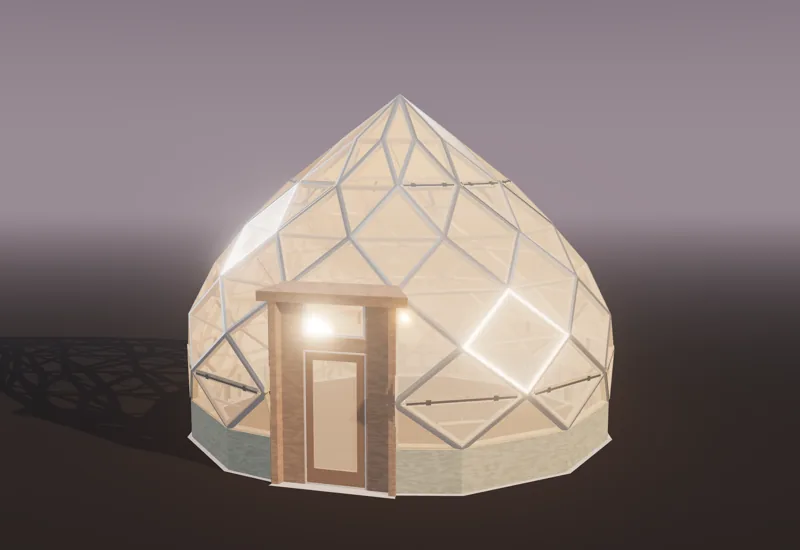
A zome greenhouse is a glazed shell of flat diamond panels that spiral up to a star. It’s taller than a dome of the same floor, so nearly all of it is standing room. Glazed diamonds don’t brace themselves, though: each needs a level rail across its middle, and the vents must hang from those rails.
This guide covers why the shape grows well, the bracing fact that every glazed zome has to deal with, where vents can and can’t go, how to size one under the common permit lines, and what the glazing really costs. The numbers come from our three Spica Zome greenhouse models and the Harvest Moon greenhouse-and-coop, each built and checked part by part. For the geometry itself, start with what a zome is.
Why a zome for growing
Height on a small floor. A zome’s lower rings rise steeply off the wall, so headroom arrives close to the edge. On our 8-fold Spica Zome 12, 71 of its 90 sq ft (79%) has 6’-8” (2.03 m) or more overhead. A 2V geodesic dome of similar floor, our Solstice Dome 12, manages 52 of 101 sq ft (51%), even on a taller knee wall. At 16 feet across the two shapes come out about even; at 25 feet the zome has standing room over about 99% of its floor.
A tall stack. Hot air rises into the star, high over the plants. On the Spica 16 it can pool as much as 5’-2” above the hinges of the high vents. That keeps the worst of the heat off the crop, but it’s a reservoir rather than a chimney, for a geometric reason explained below.
Fewer, larger panels. The Spica Zome 16 has 59 panels to the comparable dome’s 101. It does need more jig shapes: 9 against the dome’s 4, because a zome’s diamonds change shape ring by ring.
The look. A zome’s edges trace spirals: an n-fold zome has n spirals running each way, so a 10-fold Spica has 10 left-handed and 10 right-handed. Those counts are the fold count, not Fibonacci numbers, and an 8-, 10- or 12-fold zome has no golden ratio in it. The golden rhombus belongs to icosahedral zonohedra and to Zometool, not to these shells (Hart, The Joy of Polar Zonohedra).
Zome vs dome at the same size
| Spica Zome 16 | Solstice Dome 16 | |
|---|---|---|
| Shell | 10-fold zome, every edge 3’-0” | 3V 5/9 geodesic dome |
| Across | 16’-1 9/16” (4.92 m) | 16’-0 5/8” (4.89 m) |
| Floor inside the knee wall | 160 sq ft | 182 sq ft |
| Height, ground to top | 13’-5 1/4” (4.10 m) | 11’-11 11/16” (3.65 m) |
| Standing room (6’-8”) | 140 sq ft (88%) | 159 sq ft (87%) |
| Glazing | 404 sq ft on 25 sheets | 436 sq ft on 26 sheets |
| Vents open / needed | 44.8 / 32.0 sq ft | 47.4 / 36.5 sq ft |
| Parts | 59 panels, 223 struts, 46 rails | 101 panels, 303 struts |
| Jigs | 9 | 4 |
| Frame weight | about 990 lb (450 kg) | about 1,130 lb (513 kg) |
| Worst corner lift, 115 mph | about 510 lb | about 220 lb |
All from our built models. The dome is simpler to jig and grips the ground better; the zome is taller, has fewer panels and stands better on a small floor. The dome greenhouse guide covers the dome side in full.
The bracing fact: glazed diamonds need rails
A diamond of four struts is a parallelogram, and a parallelogram racks: push one corner and it folds flat without any strut changing length. On a solid zome, plywood skin stops that, because the sheet is stiff in its own plane. Twin-wall polycarbonate isn’t. It would pull its screws long before it stiffened anything.
When we built the first glazed Spica and ran the frame through a truss check, the plain diamond shell had more than 20 collapse modes: ways the frame can move with no member stretching. That’s not a weak frame; it’s a mechanism.
The fix is a level rail across each diamond’s horizontal diagonal. It splits the diamond into two triangles, which can’t rack, and the rails in each ring join into closed level rings. With them the frame stands on its own and the panes carry nothing but weather:
- Spica Zome 12: hardest-loaded strut about 450 lb under 30 psf (1.44 kPa) of ground snow, the frame moving less than 1/16” on paper.
- Spica Zome 16: about 610 lb, less than 1/16”.
- Spica Zome 25: about 1,290 lb. Its rails also carry real tension low in the shell (up to about 760 and 1,000 lb in rows 5 and 6), so those rails get a second steel plate at each end, bent from the rail onto the strut above.
Each rail is a square-cut 2x4 with a galvanized tie plate at each end. It doesn’t apply where plywood does the bracing: on our coops, a glazed window diamond in a plywood shell needs a rail only if the pane needs one to come from one sheet.
Where the vents can go
Here the geometry decides for you. In a polar zonohedron every edge has the same slope (George Hart’s paper shows this), so no edge of any diamond is level. The one level line in a diamond is its horizontal diagonal, which is exactly where the rail runs.
So a zome sash is the lower half of a diamond, hung from its rail on two hinges, lifted at its tip by an opener. The upper half stays fixed glass. That has three consequences:
- No vents in the star. The star’s diamonds are so narrow that a half-diamond sash there would open only about half as much as one lower down, and it would hang where you’d need a ladder over the floor. Our Spicas keep the star closed and glazed.
- High vents sit a few rows down. On each Spica the high sashes fill one ring (every diamond but the one over the door) and the low sashes take the first two diamonds either side of the door, on the sunny side so the air they let in is already mild.
- The stack is shorter than the building. On the Spica 16 the low and high sashes’ centers are about 3’-10” apart, against about 5’-4” on the comparable dome. By our estimate (method in the dome guide), on a still day the Spica 16’s sashes move about 940 cfm (1,600 m³/h) with the inside 10°F warmer than outside: roughly 0.6 of its air volume a minute, short of the one air change a minute that UF/IFAS gives for summer. The door adds about 20 sq ft, a breeze does the rest, and in a hot climate a fan earns its place.
| Plan | Sashes (high + low) | Open / needed (20% of floor) | High hinges | Low openers |
|---|---|---|---|---|
| Spica Zome 12 | 7 + 4 | 34.1 / 17.9 sq ft | 7’-8 3/8” (12” step) | 3’-11 1/2” (floor) |
| Spica Zome 16 | 9 + 4 | 44.8 / 32.0 sq ft | 7’-10 1/4” (12” step) | 4’-0 5/16” (floor) |
| Spica Zome 25 | 11 + 4 | 99.1 / 85.5 sq ft | 9’-7 13/16” (4’ stepladder) | 4’-7 5/8” (floor) |
The 20% target is our rule, in line with the 15 to 25% of floor that Alabama Extension attributes to ASABE (ACES). Every sash opens on a wax-cylinder opener, no power needed. In snow country, hook the high sashes shut for winter and bring the cylinders in, or a sunny day can try to lift a sash under snow.
Sizing under 120 and 200 sq ft
Permit exemptions for small detached buildings are commonly 120 sq ft (11.1 m²) or 200 sq ft (18.6 m²); the permit guide explains where each comes from. A zome bulges past its own wall, so the area depends on where you measure. We size each Spica to stay under the line inside the knee wall, at its outside face, and under the shell seen from above:
| Plan | Folds, edge | Inside knee wall | Outside of wall | Under the shell | Height |
|---|---|---|---|---|---|
| Spica Zome 12 | 8, 2’-11” | 90 sq ft | 102 sq ft | 118 sq ft | 11’-4 1/16” |
| Spica Zome 16 | 10, 3’-0” | 160 sq ft | 176 sq ft | 194 sq ft | 13’-5 1/4” |
| Spica Zome 25 | 12, 4’-0” | 427 sq ft | 452 sq ft | (permit) | 19’-5 5/8” |
Two of these sizes came out of failed first passes, and the reasons are worth knowing if you design your own:
- The 12 started as an 11. At the planned 2’-8” edge, a 2’ knee wall left only 6’-5 1/4” under the door head, short of a standard 6’-8” door, and 9-fold shells under 120 sq ft had the same problem. Eight folds at a 2’-11” edge gives a 6’-10 7/16” rough opening for a 36” x 80” prehung door.
- The 16 started as an 18. A 10-fold shell at a 3’-3 7/8” edge measured 197 sq ft inside its knee wall, but 214 to the wall’s outside and 236 under the shell. A 3’-0” edge is the biggest that clears 200 every way.
The Spica 25 is a market-garden size and needs a permit almost anywhere. Its wind uplift (about 1,020 lb at the worst corner at 115 mph) is why its footing ring is 18” deep: about 14,600 lb of concrete. Our structural figures are checks, not engineering; have them reviewed for your snow, wind and soil, and confirm sizes with your building department.
Each Spica’s top-panel angle times its fold count is about 287° (35.875° x 8, 28.7° x 10, 23.92° x 12). That’s our family rule: it keeps the star’s points equally full at every size. It also puts every edge at a pitch of about 36.5°, close to the 35.26° that Hart shows gives a polar zonohedron its most volume for a given edge length.
Glazing: twin-wall, and the sheet you’ll waste
Every Spica is glazed in 8 mm twin-wall polycarbonate under bent aluminum caps, with the flutes running down the panel so condensation drains, solid tape on the top edges and vented tape on the bottom. (The dome guide compares twin-wall with glass and film.) What surprises people is the waste. A zome’s middle-ring diamonds are close to square and too wide to cut two across a 4’ sheet, so each sheet leaves a long offcut:
| Plan | Panes | 4’ x 8’ sheets | Plastic used |
|---|---|---|---|
| Spica Zome 12 | 249 sq ft | 15 | 52% |
| Spica Zome 16 | 404 sq ft | 25 | 51% |
| Spica Zome 25 | 1,016 sq ft | 57 | 56% |
Budget about twice the pane area in sheet, and keep the offcuts for repairs and cold frames. (Our dome greenhouses land at 50 to 57% too, for different reasons.) For a colder winter, 16 mm sheet insulates better, about R-2.5 against R-1.7 (RSI 0.44 against 0.30), at some cost in light.
The Harvest Moon: a greenhouse with a coop in its back
The Harvest Moon is a 9-fold zome greenhouse, 14’-5 5/16” across and 13’-0 1/4” tall, with a coop for up to six hens built into its three back sides. It uses the shell of the retired Spica 14 on a 3’ knee wall, so the nest boxes can stand 18” off the floor.
- Two halves of one shell. 27 glazed panels over 109 sq ft of beds; 17 panels in plywood over the coop and the crown. The plywood shades the hens, holds warmth on the cold side and braces the frame there, so only the glazed diamonds take rails. Face the coop north.
- The partition. A 2x4 wall on the chord between the coop’s two front corners: a 24” plywood kick on the bed side to keep litter in, hardware cloth on the coop side up to the shell, a 30” screen door for you and a 12” x 15” pop door for the hens.
- Two vent systems. The hens’ air rises through the partition’s cloth to a crown vent that never closes: 9.2 sq ft against 6 needed (1 sq ft per hen). The beds get 10 sashes, 32 sq ft against 22 (20% of 109).
- The coop. 25.5 sq ft for six hens, 4.3 sq ft each, plus the beds in the off-season; two nest boxes opened from outside; an automatic pop door to a run.
How the year goes: in the growing season the hens stay in the coop and run. After harvest you open their pop door into the beds, where they scratch out weeds and grubs and leave manure. In spring you shut them out, rake the beds over, let the manure age a few weeks and plant. Never put fresh manure on crops you’ll eat soon.
The trade-offs are real. The hens’ heat and breath help a little in winter, but six birds won’t keep frost out. Their air, ammonia and dust included, passes over the beds on its way out, which is why the crown vent can never be shut. And the coop must still meet your local rules for keeping poultry. Our zome chicken coop guide covers space, ventilation and predators in detail.
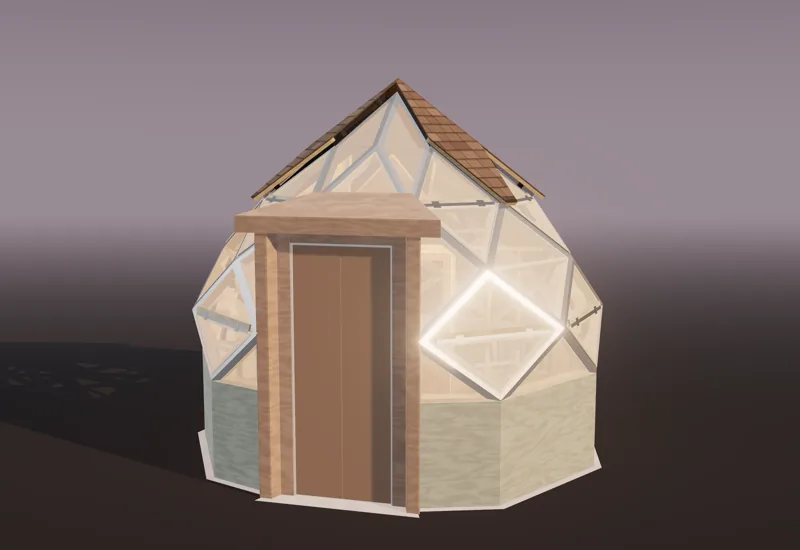 Plan · Coop · Greenhouse + coopHarvest Moon ZomeA zome greenhouse with a six-hen coop built into its back.14'-5 5/16"139 sq ftfrom $59
The Spica line at a glance
All three Spicas are shells on a poured footing ring, its top level with the floor so a wheelbarrow rolls in, with a 2’ knee wall, 2x4 struts on edge (a 2x3 edition uses the same jigs and comes out 27 to 29% lighter), a rail in every diamond, automatic sashes, and a 36” full-lite door with no posts beside it: the rail rings carry the door head. The floor inside is yours to lay out.
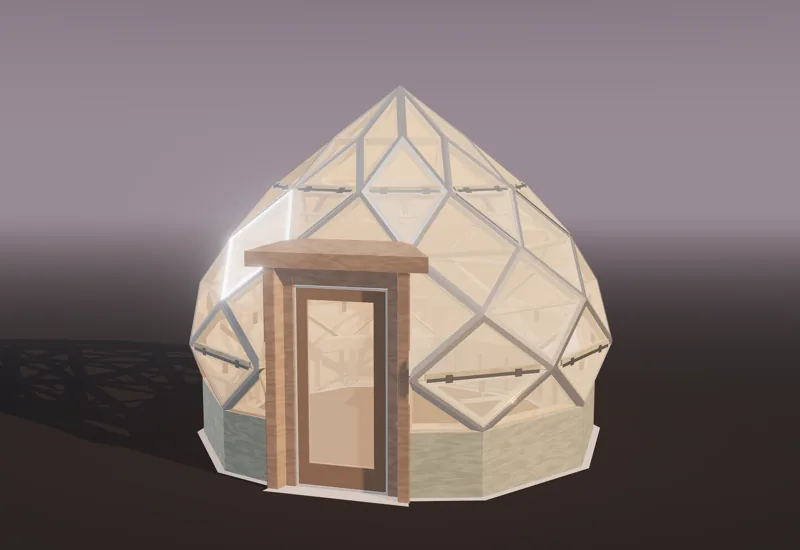 Plan · Greenhouse · Backyard greenhouseSpica Zome 16The greenhouse line’s most standing room for its size: 88% of 160 sq ft.16'-1 9/16"160 sq ftfrom $59
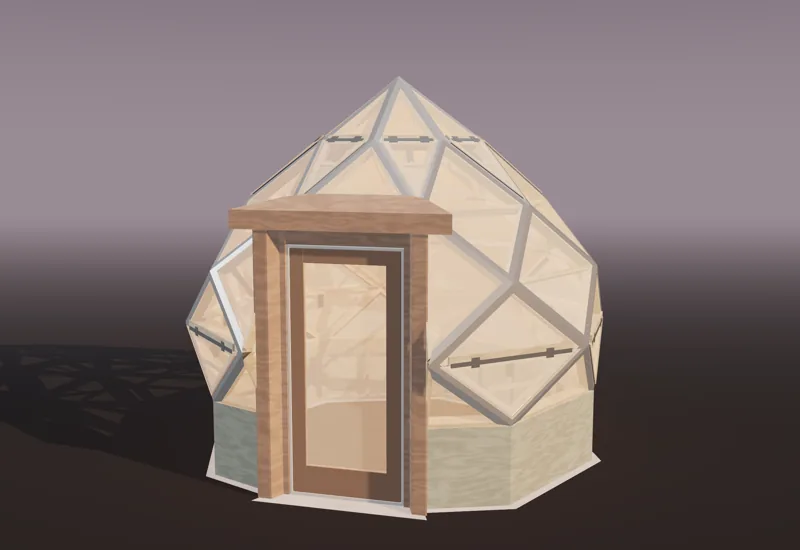 Plan · Greenhouse · Backyard greenhouseSpica Zome 12The biggest zome greenhouse that stays under 120 sq ft.12'-9 11/16"90 sq ftfrom $59
To try other fold counts and edge lengths, the zome calculator computes panel angles and floor areas, and the glossary defines every term used here.
Questions
Q01What is a zome greenhouse?
A greenhouse whose glazed shell is cut from a polar zonohedron: rings of flat diamond panels spiraling up to a star at the top. It is taller than a dome of the same floor and has near-vertical lower walls, so most of the floor has standing room.
Q02Does a glazed zome need extra bracing?
Yes. A diamond of four struts racks like a parallelogram, and twin-wall polycarbonate adds no useful shear stiffness. A level rail across each diamond's horizontal diagonal splits it into two triangles and ties the shell into level rings.
Q03Can the vents go at the top of a zome greenhouse?
Not easily. No edge of a zome diamond is level, so the only level hinge line is the rail across a diamond's middle. The star's narrow diamonds would open only about half as much as the lower ones, so the high vents go a few rows down.
Q04What size zome greenhouse avoids a permit?
Where the exemption is 120 sq ft, an 8-fold zome with a 2'-11 inch edge (90 sq ft inside, 118 under the shell) is about the largest. Where it is 200 sq ft, a 10-fold zome with a 3-foot edge (160 inside, 194 under the shell). Confirm with your building department.
Q05Is a zome greenhouse the same as Zometool?
No. Zometool is a construction toy built on icosahedral geometry and the golden ratio. A greenhouse zome is usually an 8- to 12-fold polar zonohedron, which has no golden ratio in it.